
FÜRST FIRST: The Fürst Family's Quiet Rise to Superstardom
A Pinot Noir and Riesling Kingdom, built on Red Sandstone
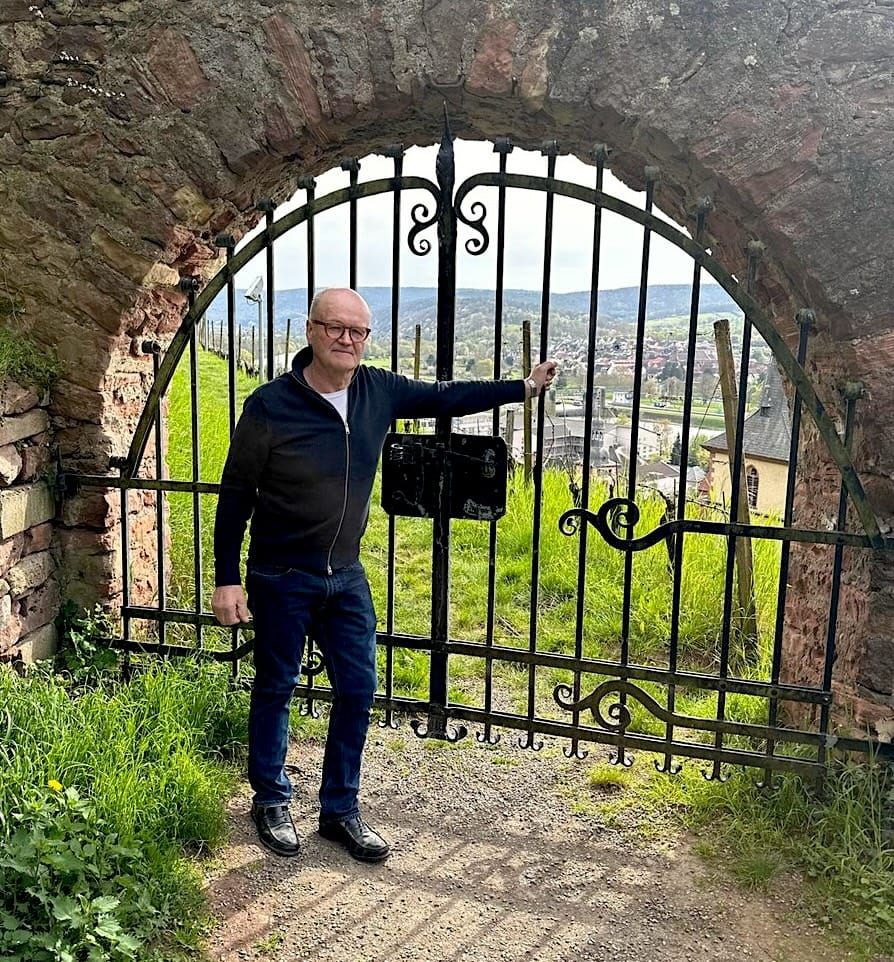
Text and tastingnotes (with one exception) by Frank Ebbinghaus - latest revision: 02.09.26
The Fürst winery’s rise to become a leading estate was a gradual process. When the German Wine Miracle took place in the late 1980s and early 1990s, it was predominantly the producers of dry and noble sweet Rieslings who were celebrated. A new, young and cosmopolitan generation of German winemakers from the Mosel, the Nahe, the Palatinate and the Rheingau attracted considerable international attention. A short distance further to the east, at the western tip of Franken, things remained quiet.
Although Paul Fürst had been producing outstanding Rieslings from 1979, his winery’s reputation was founded on a different grape variety: Pinot Noir . The wine world at that time took considerably less interest in this variety. Yet even back then, Fürst was producing magnificent Pinot Noirs that were unrivaled in Germany. I vividly remember the 1990 Bürgstadter Centgrafenberg Pinot Noir, which utterly fascinated me in the mid-1990s with its extremely refined, elegant and entirely un-oaky style. I'd never before tasted such Burgundian finesse from a German wine. This wine was still in remarkably fine condition in December 2024 at a major Fürst vertical tasting in Berlin.
But in the early nineties, such wines were very rare and remained a footnote. And so it came to pass that Paul Fürst created his own wine miracle. And that really took off from the late nineties onwards. Since the 1997 vintage, he has been producing great Pinot Noirs with a consistency that continues to this day. A 1997 Frühburgunder R tasted in February 2019 displayed irresistible freshness, sensuality and complexity. The rare Frühburgunder grape is a German mutation of Pinot Noir, and no one produces better wines from this grape than Fürst.
The fact that the Fürst winery has so quietly and unobtrusively established itself amongst the absolute elite of German viticulture is not solely down to the calm temperament of Paul Fürst and his son Sebastian, who has been in charge of the winemaking for several years now. A few other factors also play a part.
Take the location, for example: the Mainviereck – the area between Aschaffenburg, Gemünden am Main, Wertheim and Miltenberg – has distinctive characteristics that set it apart from the Franken wine-growing region to which it belongs. There is, for one, its historical affiliation with the Electorate of Mainz, which lasted until the early 19th century and is still evident in the local dialect today. Furthermore, the red sandstone, which predominates in Chur-Franken - as the proud West Franken call their region- and is omnipresent in the local townscapes, represents a distinctive geological feature compared to the Muschelkalk (shell limestone) of Central Franken and the Keuper (gypsum marl) soils found in eastern Franken. It is also warmer here than anywhere else in Franken. And Chur-Franken wine-growing region is quite a small collection of sloping vineyards with broad terraces and steeply-sloping vineyards with narrow terraces.
The fact that there is nevertheless a long-standing wine-growing tradition here – one upon which the Fürst winery also draws – is probably known only to die-hard connoisseurs. Viticulture has shaped the region since the Middle Ages – with all its ups and downs. Following a decline in the 19th century, a new golden age of viticulture began at the start of the 20th century, which, despite crises, wars and disasters, laid the foundations for the resurgence that began during the 1980s.
Whilst the great wines of the 1910s and 1920s from the Mosel, Rheingau and Nahe have achieved legendary status, hardly anyone is familiar with their Chur-Franken counterparts. However, at the aforementioned Fürst vertical tasting in Berlin in December 2024, Paul Fürst brought a wine that not only tasted breathtaking but also opened people’s eyes to the great Chur-Franken wine tradition. The 1915 Eichenbühler Klausrein Burgunder Eigenbau Naturrein by Georg Ramloch in Miltenberg tasted like an excellent Burgundian Pinot Noir from the 1980s. The table abruptly fell silent. And we all suddenly understood on whose shoulders the Rudolf Fürst winery stands.
For Paul Fürst, looking to Burgundy is at least as important as tradition. In this way, he has found his own style with great self-assurance. From the very beginning, Paul Fürst steered clear of the trend for heavy Spätburgunder wines – produced from overripe grapes and aged in plenty of new oak – which were typical in Germany during the 1990s and 2000s. His focus has always been on finesse and freshness. He would rather have a few degrees Oechsle less, in exchange for more delicate and fresher fruit aromas plus brighter acidity.
German wine critic Stephan Reinhardt dubbed him the „Einstein of Chur-Franken Frühburgunder and Spätburgunder“ in the book Wein spricht deutsch (Wine Speaks German), published by S. Fischer in 2007. A bold claim. What supports it is that Paul Fürst has changed the German wine world with his ideas by developing an elegant red wine style that, tosome degree, came to define the new red wines of Germany. A style which, incidentally, is being seamlessly continued by his son Sebastian. In fact, one gets the impression that Sebastian Fürst has taken the fine-tuning of the wines several step further.
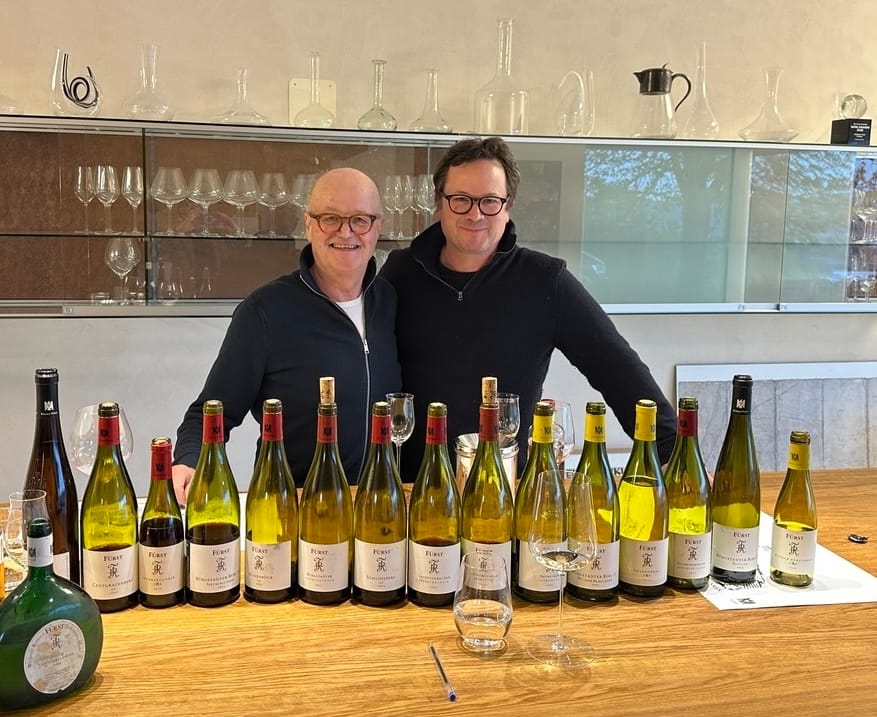
A small vertical tasting conducted in April 2026 with Stuart, featuring Pinot Noir Große Gewächse, or GG, from the Centgrafenberg vineyard spanning the vintages from 2015 to 2023, demonstrated just how precisely the winemaking is tailored to the specific conditions of each vintage. For instance, the use of oak was clearly significantly reduced in the lighter vintages of 2016 and 2021 so as not to overwhelm the delicacy of the fruit. And however different vintages such as 2018 and 2021 may be, they are united by their delicacy and excellent tannin quality.
Cool, silky, highly sensual, elegant, complex and full of intrigue, yet completely effortless: all these words can scarcely do justice to the experience offered by Fürst’s Pinot Noir – especially when it has been allowed to mature for a few years. Even the regional wines are extremely impressive (though so are their prices). At the very top (in terms of price too) is the Hundsrück, a wine that rivals the Grand Crus of the Côte de Nuits in terms of sensuality, elegance, depth and aging potential.
However great the acclaim for the Pinot Noir wines may be, it would be presumptuous to limit Fürst exclusively to these. For Paul and Sebastian Fürst have also achieved mastery with Pinot Blanc, Riesling and Chardonnay. Here, too, they are continually refining their style. For several vintages now, the top-quality Pinot Blanc and Chardonnay wines, marked with an ‘R’, have been produced without stirring the lees (bâtonnage). Rather than creamy richness, Fürst now focuses on freshness and mineral finesse. Consequently, wines such as the 2023 Chardonnay Astheimer and the 2023 Chardonnay Bürgstädter Berg, with their precise, cool minerality, are reminiscent Chablis, whilst the 2023 Chardonnay R tastes like a great Burgundy from the Côte de Beaune.
And what about the Riesling? In his 1994 book Die großen deutschen Rieslingweine (The Great German Riesling Wines), Stuart wrote: “Unjustifiably, his Rieslings are less well known and appreciated, even though they are of a similar quality to his barrique wines.” This is truer than ever today. The bone-dry top-quality Rieslings from Bürgstadt’s Centgrafenberg, with their concentrated minerality and cool finesse, are among the best in Germany. And this has been the case not just with the most recent, excellent vintages. A dry 2004 Bürgstadt Centgrafenberg Riesling tasted in April 2026, was still very fresh and tasted like the pure expression of the iron-rich sandstone soil of the Centgrafenberg – a unique wine, like all the Fürst wines.
A FEW AMAZING FÜRST EXAMPLES
Fürst Franken Riesling Centgrafenberg GG 2025 - 12.5% / Where the blossoms meet the the garden herbs and the white tree fruits there’s a waterfall which splashes over mossy rocks. Incredibly focused on the sleek and pristine palate. Electric vitality at the almost endless finish! Enormous aging potential. 97 (SP)
Fürst Franken Chardonnay R 2023 – 12.5% / A hint of wood and smoke, stones, lemon balm, lemon, marvellous acidity and freshness. Wonderfully balanced, superbly refined, hardly any fruit yet, but the finest apricot notes emerge in the empty glass. A delight to drink even now, with a texture on the palate reminiscent of the finest red sandstone. 96 (FE)
Fürst Franken Spätburgunder Hundsrück GG 2024 – 13% / Very restrained on the nose, cool, redcurrant, a hint of beetroot. With aeration, raspberries emerge. Becomes sweeter. Enormously silky. A silk carpet is laid out, upon which raspberries and cherries are arranged as in a Japanese delicatessen. The fruit has just a hint of sweetness, and that’s all it takes to make this wine’s aromas truly shine. It doesn’t necessarily seem any more powerful than the ‘standard’ Centrafenberg GG, but it is even more elegant and refined. 99 (FE)
Fürst Franken Spätburgunder Centgrafenberg GG 2023 – 13% / Does not seem quite as ripe and juicy as the 2022, but is slightly more refined. Wonderful nose of delicate wood, vineyard peach, sweet cherry, redcurrants, a hint of tomato. Very refined and ripe, yet also very delicate; on the palate, very refined, silky, ripe fruit with wild strawberry. Great potential! 97 (FE)
30 wines tasted. All rated at least 90 points