HESSIGHEIM: Episode One
Where the Wine Crisis is Giving Rise to New Superstars
By Frank Ebbinghaus - last revision 01.06.26
PART ONE: The Crisis
Hessigheim? Even many seasoned wine lovers will probably start by reaching for Google: “A municipality in the district of Ludwigsburg, about 25 km north of Stuttgart,” is the somewhat dry description on Wikipedia. That’s as you’d expect for a town with just 2,500 inhabitants and plenty of countryside, but no other attractions – or are there? On the Hessigheim municipal website, it sounds far more promising, but perhaps a bit idealized: “Hessigheim forms the golden heart of Württemberg’s wine-growing region and is blessed with the gifts of nature.”
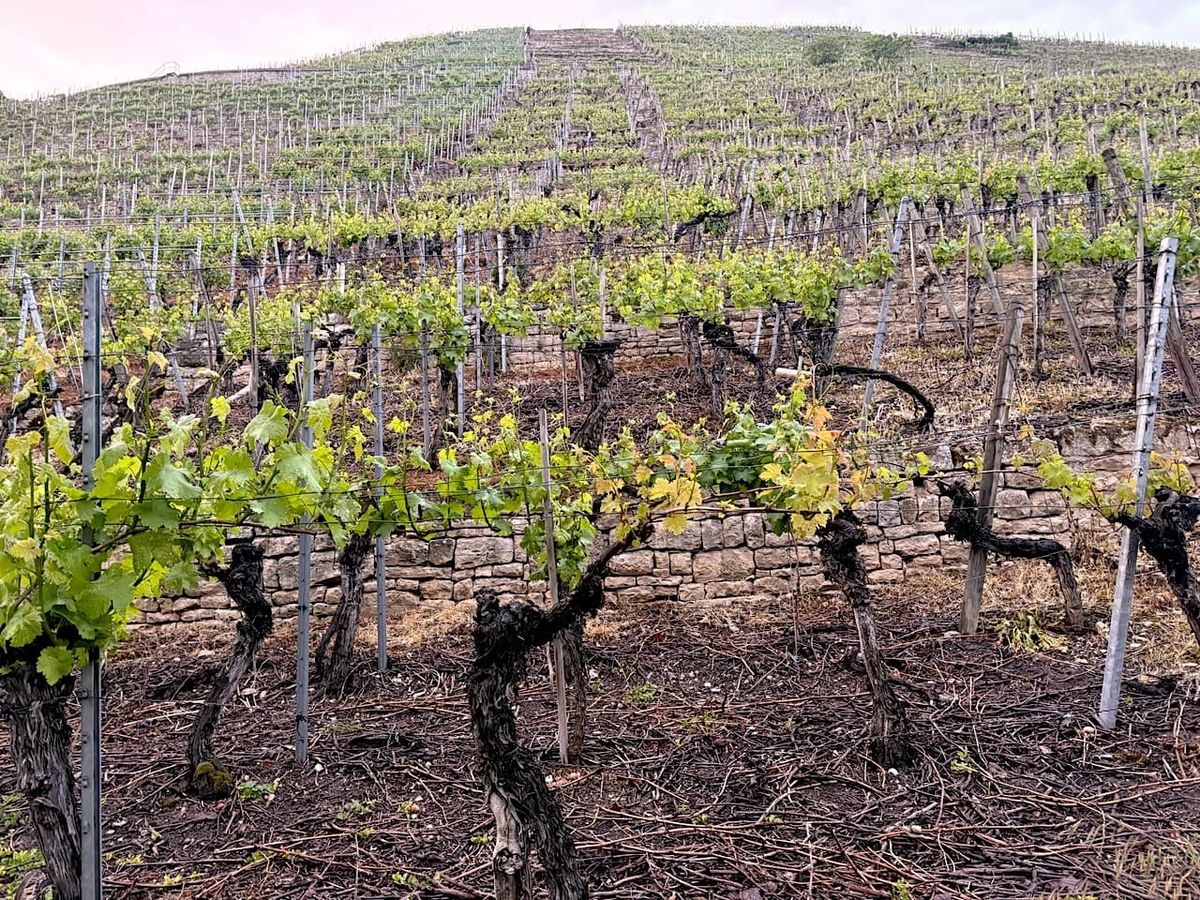
The latter immediately strikes any visitor: the breathtaking, terraced slopes with their drystone walls along the loop of the Neckar River instantly captivate you. Here, the vines grow on almost impenetrably hard and barren shell limestone soils. Looking at this fascinating cultural landscape, one cannot help but wonder: why have we heard so little about the wines produced here until now?
The answer lies in a large building complex on the outskirts of Hessigheim, effectively the town’s industrial estate: this is the home of the Felsengartenkellerei Besigheim winegrowers’ cooperative, an association of around 300 winegrowing families who cultivate 550 hectares of vineyards here. For a long time, the cooperative ensured prosperity in the region. A patch of vines were worth their weight in gold. Winemaker Siegfried Mayer, whose great-grandfather was a founding member of the cooperative, reports that his uncle financed his studies through the vineyards. Do the math and it’s obvious: a kilo of grapes fetched 3.50 Deutschmarks (approx. 1.75 euros) back then, and 30,000 kilos of Trollinger per hectare was a realistic harvest yield. With two hectares of vineyards in the cooperative, you were rich! Sales were booming. Of course, at thistime it was never about wine quality. Because the money rolled in thanks to the huge volume.
But that world is gone. In the late 1990s, cheaply produced mass-market wines from overseas and southern Europe began to flood the German market and dampen the gold-rush atmosphere among the Hessigheim cooperative members. And currently, the Global Wine Crisis is hitting Baden-Württemberg particularly hard. 800 hectares out of a total of 1,300 hectares of vineyards abandoned nationwide in 2025 are in this federal staate. According to the German Wine Institute, this is linked to the high proportion of red wine produced there, which is no longer en vogue. Labour-intensive steep-slope viticulture is suffering everywhere, and this is also evident in Hessigheim. In the Wurmberg, that impressive terraced vineyard site, there are several gaps – an ominous sign of the threat to viticulture on this steep slope.
PART TWO: The Birth of New Superstars
Crisis also means opportunity. For a good ten years now, a new, quality-oriented wine culture has been emerging in Hessigheim. These are young, well-educated, highly ambitious men and women who recognised the treasures of Hessigheim’s unique terroir. They explored the world of wine before (re)discovering the narrow Neckar Valley for themselves. Some have their roots in Hessigheim and have witnessed first-hand what is going wrong with the local viticulture.
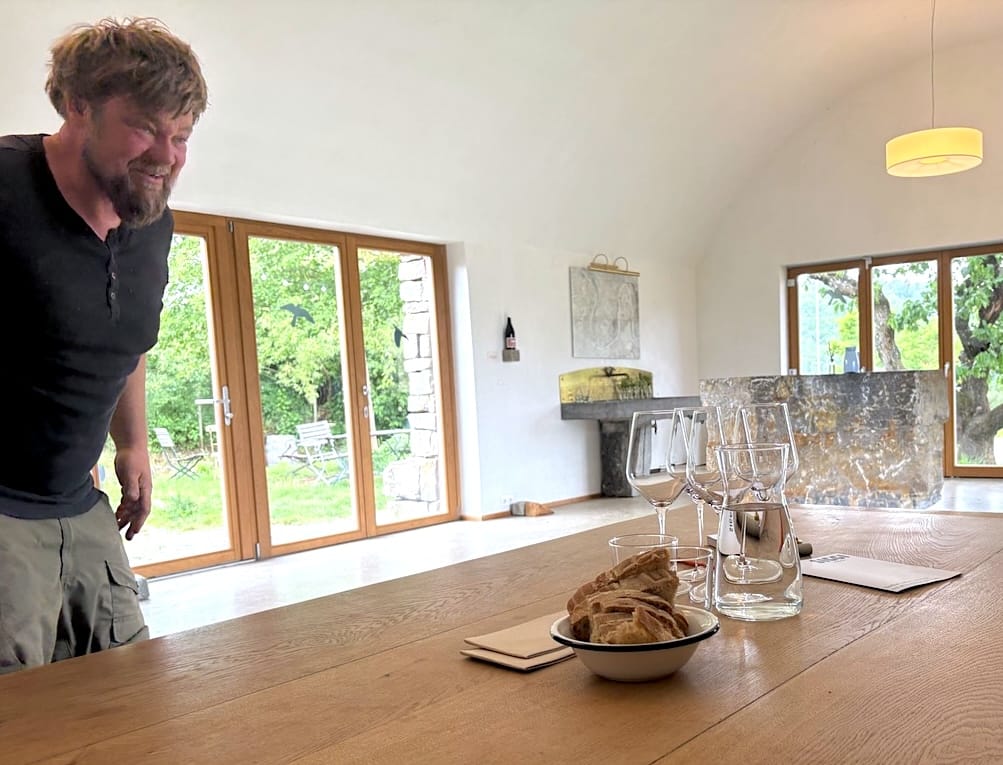
After two visits to Hessigheim and extensive tastings, I venture the following hypothesis: a new generation of superstars of Württemberg viticulture is currently emerging in Hessigheim. Their names are Fabian and Stefanie Lassak, Alexander and Eva Eisele, and the aforementioned Siegfried ‘Siggi’ Mayer. They each manage vineyards ranging from between four and just under eight hectares. Despite all the stylistic differences between them, their wines are all marked by the barrenness of the shell limestone soils; the white and red wines taste intensely mineral and fresh, usually with low alcohol levels, and they’re always refined and distinctive. This creates a very specific sense of place.
Since 2021, two more promising estates have emerged in Hessigheim: the ExNicrum winery, run by Fabian Alber, and Ruben and Tatjana Eisele’s mini-winery, Rubens Wein. Both represent exciting additions to Hessigheim’s ambitious community of winemakers. Yet their path to the top still seems a long way off – more on that later. And of course I also spoke to Sebastian Häußer, the oenologist and manager of the Felsengartenkellerei, and tasted some of the cooperative’s wines. (For the sake of completeness, the Faschian winery should also be mentioned; it has transferred its best vineyards to ExNicrum and now produces basic wines. I did not visit the Faschian winery nor did I taste its wines).
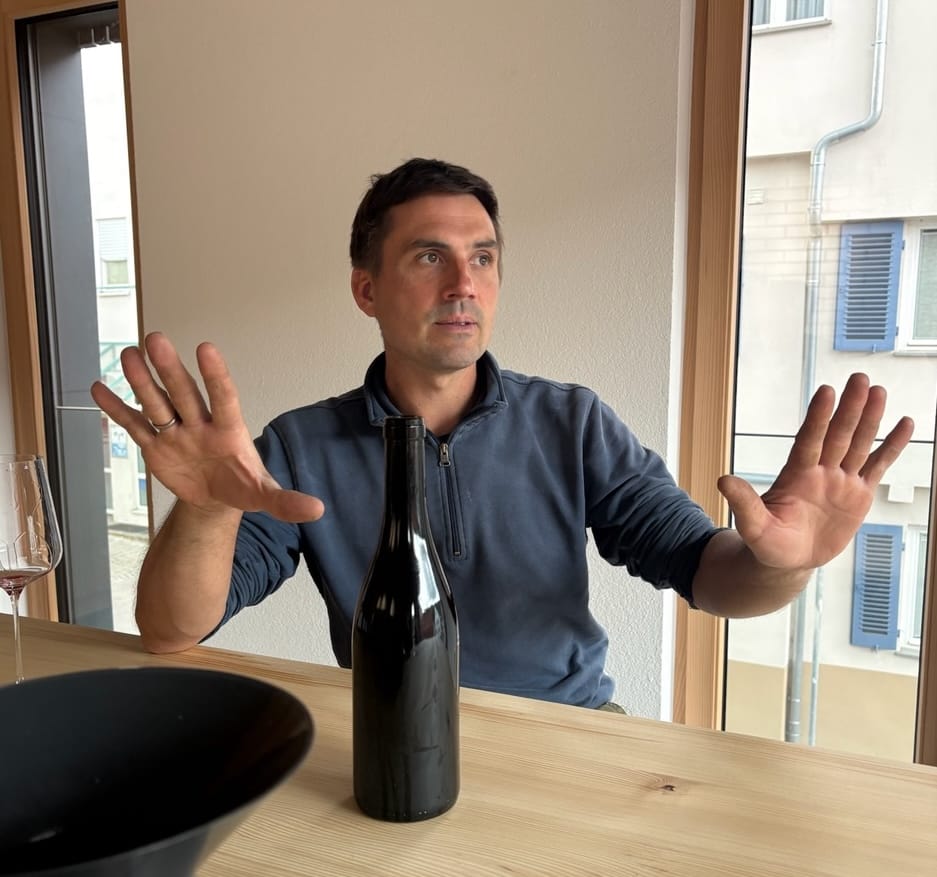
Anyone lamenting the fallow land on the terraced steep slopes might easily overlook the fact that the crisis is also a blessing for Hessigheim’s ambitious winegrowers. Gone are the days when the precious, unconsolidated plots were not available forpuchase. “In the cooperative’s heyday, a hectare cost 50,000 euros, if anything was even up for sale,” reports Fabian Lassak. Today, one can acquire prime vineyards for 8,000 euros per hectare. When Siegfried Mayer started “from scratch” in 2012, he leased a steep slope in Neckarwestheim. In Hessigheim, it used to be too expensive. Now he can choose his own vineyards.
Two “unintended” wines from Lassak and Siggi, made from newly acquired plots, demonstrate just what wonderful discoveries can be made in the process. Lassak managed to get his hands on two plots in Wurmberg planted with 70-year-old Trollinger vines. “We never wanted to make Trollinger,” said Fabian Lassak. But instead of grafting over or replanting, he harvested the grapes and, from a small yield, produced a sensationally fine, dense, complex Trollinger that disproves every prejudice against this grape variety. Siegfried Mayer had a similar experience when he was offered an old Silvaner vineyard. He, too, decided to harvest the grapes. And his 2024 Galgenberg Silvaner trocken is so successful that any top Franconian winery would be proud of it.
The fact that young wineries can buy into the best vineyard sites is a key prerequisite for the continued success of Hessigheim’s winegrowers. In spite of climate change, it is only in the best vineyard sites that they can produce wines of the finest quality. Equally important: these top wine-growing sites – the Wurmberg, plus the no less impressive Käsberg or Hambach – must become visible and recognisable to wine lovers. What sounds like a matter of course requires a process of learning and discovery for young winemakers. The vineyard must be explored, its character uncovered, then consumersmust recognize what’shappened. The fact that Stefanie and Fabian Lassak now include not only the name of the village or vineyard, but also the lieux-dits (French for vineyard parcel name) on the label shows just how much their knowledge has matured, and how confidently they master the terroir.
With the 2025 vintage, Eva and Alexander Eisele are also taking a major leap forward: they are using place, vineyard site and lieu-dit names instead of the two soil types (gypsum mark and shell limestone) previously named on the label. At the same time, they are focusing their top-quality wines on Riesling and Lemberger, which they produce from various lieux-dits. These changes represent a significant promise of higher quality, as the tasting of their 2025 vintage wines in cask suggests.
PART THREE: Where Does the New Path Lead?
I think it’s important to highlight the nature of learning processes for the young top winemakers in Hessigheim. There’s no established wine producer in the town who sets the standard, who could serve as a benchmark and role model. Although both the Dautel Winery and Herzog von Württemberg – both members of the Association of German Prädikat Wine Estates (VDP) – produce two and three wines respectively from vineyards around Hessigheim, their significance for these producers themselves is rather limited.
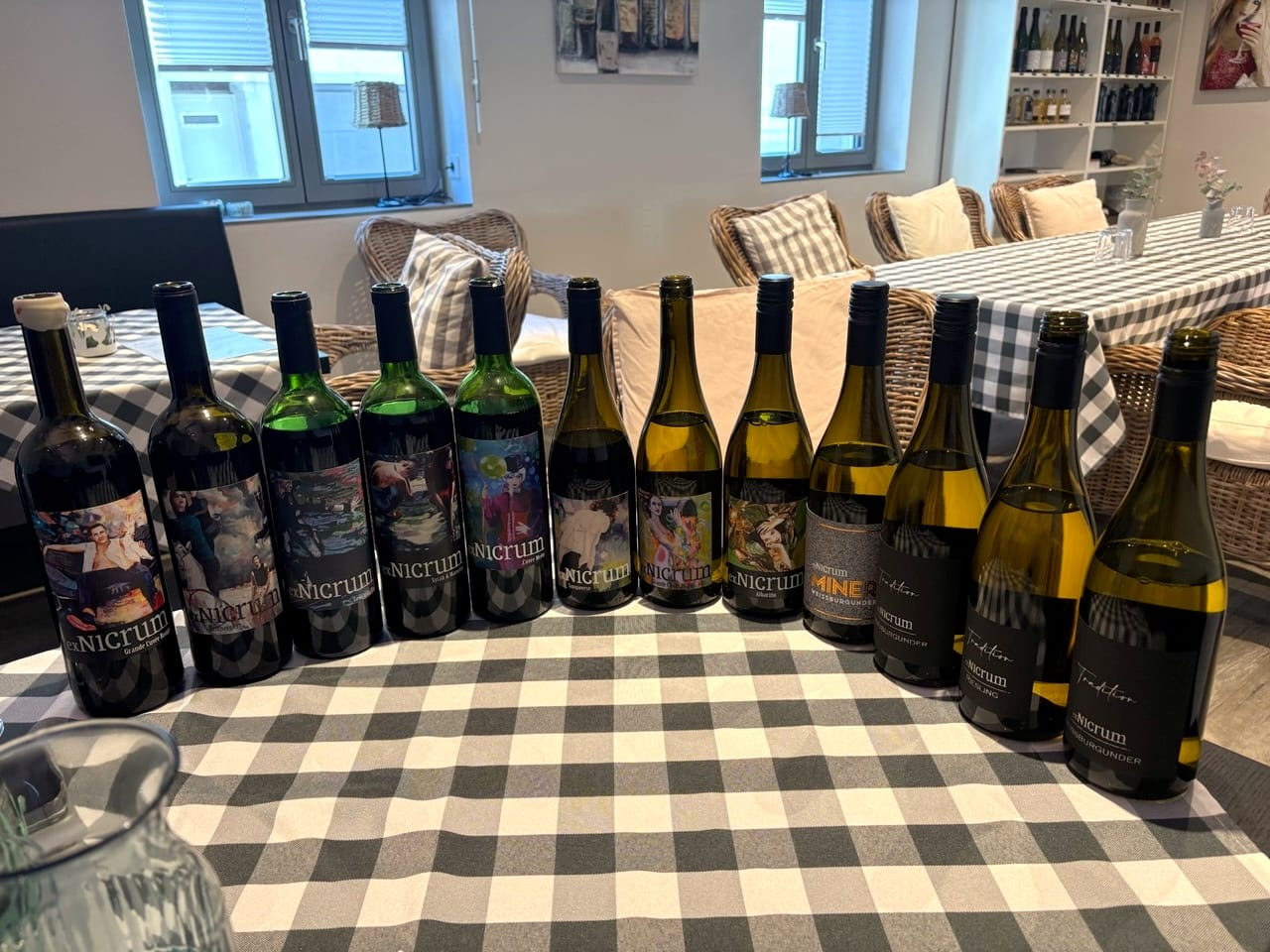
For Hessigheim’s top winemakers, there’s simply noalternative gaining experience for themselves. This also involves reflecting on the consequences of climate change with an open mind, unburdened by tradition. The steep slopes of the Wurmberg or Käsberg already heat up towards 60 degrees Centigrade on sunny summer days. So, it doesn’t take much imagination to picture what the future willbe like. Fabian Alber of the ExNicrum Winery therefore grows Sangiovese, Syrah, Tempranillo and Marselan, and produces his finest wines fromthem. In this way, Hessigheim is a becoming a laboratory for viticultural responses to climate change.
Yet, for all the enthusiasm of Hessigheim’s top winemakers, the sky is not yet the limit. All the new wine estates started with very little capital. In the early years of his independent winemaking career, Siegfried Mayer continued to work in the social services and, from 2013 to 2018 setting up and running a youth centre for the Caritas charits. He continues to run the winery today with his wife, the agricultural economist Dr. Amanda Eigner, without any employees. And it’s no different for the Lassaks and Eiseles. The Lassaks have long been an insider’s tip; their wines are so sought-after that they sell out quickly – at prices of up to almost 70 euros. However, Fabian Lassak says the volumes are far too small to justify taking on staff. So, it seems that lack of capital is currently holding back the ambitious Hessigheim winemakers. They can only gro w under their own steam, and that takes time – especially now, when wine consumption is in sharp decline.
That makes it all the more remarkable that a well-heeled investor has taken an interest in the wines of Hessigheim. Back in 2014, Herbert Müller, the former head of the German division of the auditing company Ernst & Young , planted some vineyards together with some friends. In 2021, he founded the ExNicrum winery together with Fabian Alber. The fact that a financially strong investor has committed to Hessigheim – Herbert Müller now lives in the village – rather than buying into Burgundy or the Maremma is a sure indication of how strong the upswing is.
An even more important factor is the superb quality of the wine, which after my tastings I can attest to without reservation for the three top estates. There, every wine has its own distinct character and demonstrates just how high the standard in Hessigheim is. This bodes well for the future. Hessigheim is still an insider’s tip, but…
WATCH THIS SPACE - Episode Two follows shortly!