KAMPTAL ÖTW: Higher and Higher!
The Kamptal Stands Tall Again
By Stuart Pigott - last revision: 13.07.26
Many apologies for the delay in publishing this. The first version of the text below really didn't read well, so I chucked it in the bin and rethought the whole thing. Then I was sick for a couple of days, so, finally, here it is.
PART ONE: RIED HEILIGENSTEIN ON SUPER 8
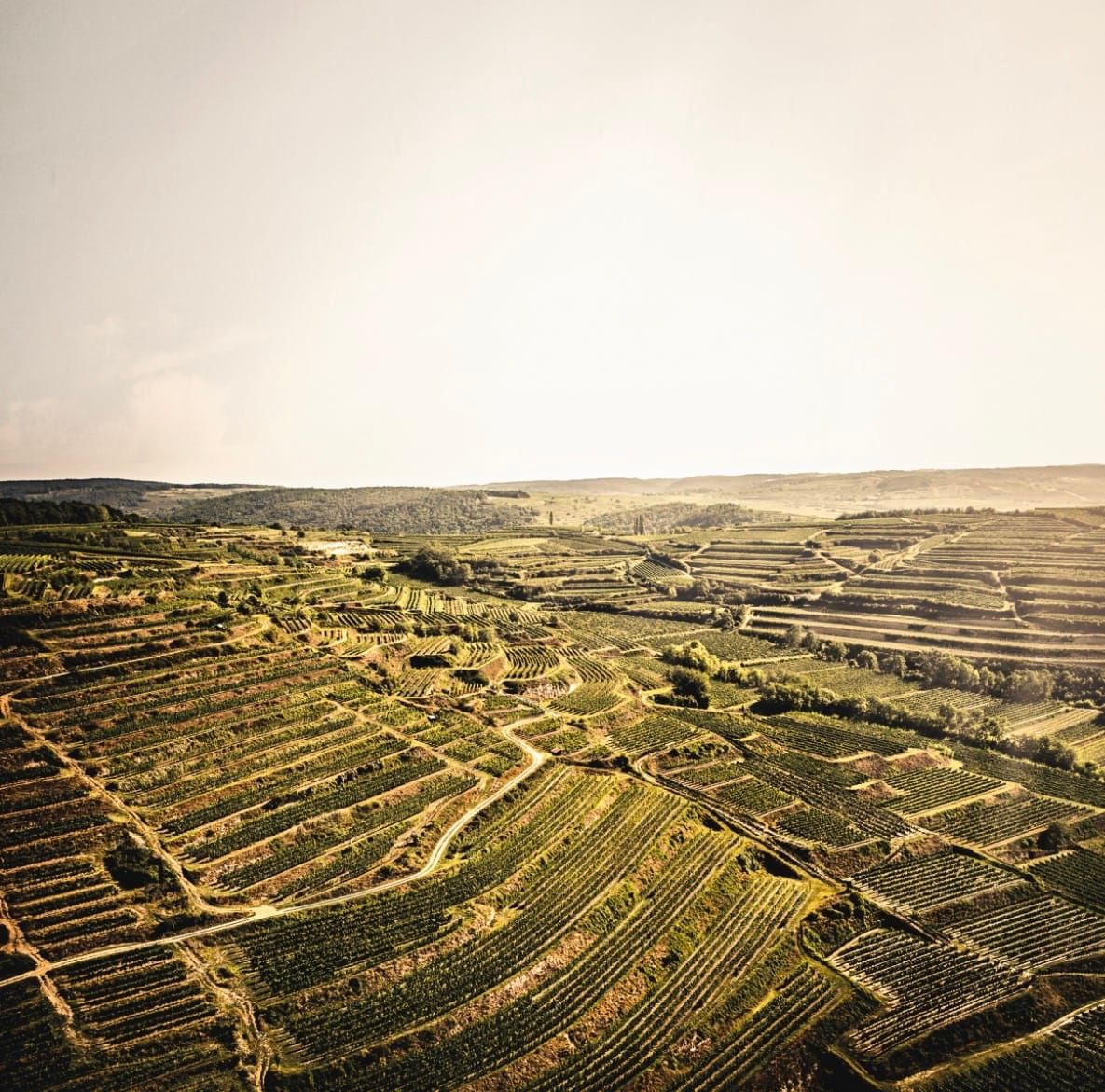
It was a grey afternoon in late November 1988 as the train from the Franz-Josef Bahnhof in Vienna to Krems on the Danube reached the first vineyards of what I think it’s fair to call the Greater Danube Area. I was fascinated by the terraces of the Wagram with their distinctive matt ochre yellow color from the loess soil. No less striking were the Kellergassen, or streets in which each „house“ was actually the entrance to a cellar that had been carved into the loess.
Then, suddenly all of this looked cute compared with what loomed in the distance, as the horizon shifted far to the towering shape of the Heiligenstein vineyard with a pointed tower on its peak. I immediately realized that the parallel horizontal lines traversing it must be vineyard terraces, and in that moment I knew that this must be one of the greatest Riesling vineyard sites in Austria, yes, the world…
Of course, that was a wonderful moment, BUT what has it to do with anything today? I think some words of explanation are needed. This story is part of a series of stories about the wines of the Greater Danube Region including the Wachau (which will come last) that is designed to bring readers up to date with the wines produced there during the last vintages. I needed to taste a lot of wines to achieve this goal, and they were sampled in tasting rooms, sometimes with the producers and sometimes not. However, even when a producer was present the fact is when you concentrate on writing notes in English it’s impossible to simultaneously conduct a probing interview with the producer in Austrian German. Much as these notes are important, particularly when taken together (also take a look those in my story about Johannes Hirsch, who is another Kamptal producer), each of them describes one specific wine and is therefore like a Polaroid snapshot.
My introduction above is more like a three minute reel of Super 8 film that I dug out of a box of keepsakes. It offers a different, and for me equally important perspective to the tasting notes. It emphasizes how the vineyards of the Kamptal how are set back to the North of the bank of the Danube (which flows roughly from West to East here), the best of them all lying over 200 meters above sea level and the vines in the Ried Heiligenstein reaching up to 349 meters. That’s what made the sight of the Heiligenstein from the railway line close to the bank of the Danube look so dramatic.
Turning to their taste, the dry Rieslings from the Heiligenstein not only have a special grainy minerality due to the Zöbing Formation bed rock (a complex congloimerate formed 250- 280million years ago during the Permian period), they also have a mountain freshness - at least in the years with a relatively cool harvest period. The latter is a quality they share with the dry Rieslings from other high altitude sites like the Ried Gaisberg and Ried Kogelberg (both belonging to Zöbing) plus the Ried Seeberg and Ried Steinmassl (Langenlois), and this is one very important side of the region. Anyone who loves Riesling or crisp dry whites with a minerally personality, but doesn’t know these wines is strongls recommended to taste some of them ASAP. You have been missing awhole chapter of the Great Book of Riesling!
PART TWO: THE LAMM LIES DOWN ON BROADWAY
The Kamptal’s excellent reputation rests on the twin pillars of those cool, intensely mineral Rieslings and the dramatically contrasting dry whites from the indigenous Grüner Veltliner grape. They are all about the interplay of fine tannins, fleshiness and spiciness on quite a generous scale. I’m not so pleased with this formulation, because it doesn’t adequately convey how exciting the aromatic and textural complexity of these wines is. And there’s also a chalky quality to them that is very distinctive. So, my words are a bit like learning about Austria in ahigh school geography lesson, actually experiencing the wines being like actually going to Austria. If you want to experience the optimum of Kamptal Grüner Veltliner, then you need to try a wine from the Ried Lamm vineyard site, if possible with a couple of years of bottle age so that the aromas are completely unfurled. Although they don’t have anything like the acidity levels of the best Rieslings from this region they can live for decades in the bottle, and my favourite age to drink these wines is 5 - 10 years of age.
What the Ried Lamm has in common with the other top sites for Grüner Veltliner in the Kamptal is that they invariably have soils based on loess over a base of much older bedrock that is either a conglomerate (in the case of Ried Lamm) or crystaline granitic type rocks. Also, these vineyards look relatively unspectacular compared to the top Riesling sites. This is not some kingd of unlucky accident, much less does it mean that Grüner Veltliner is any wayasecond class citizen. Rather, it has to do with the genetic predisposition of the Grüner Veltliner vine. It needs a relatively water-retentive and nutrient-rich soil to flourish, because of its natural vegetative vigour. Loess - a wind-blown deposit that arrived during the many ice ages during the last 2.6 million years - provides exactly what Grüner Veltliner needs. The loess and other fine material that can also hold water and nutrients tend to erode on steep slopes, sooner or later landing at the bottom of the hill. Also the foot of the hill is often where the loess collected in the first place And that’s exactly where the Ried Lamm is: the foot of the Ried Heiligenstein on the southeastern side. This is Grüner Veltliner Broadway!

PART THREE: THE TRUTH IS IN THE TASTING
I tasted all the following wines at Weingut der Stadt Krems in the city of Krems in the Kremstal region, although Langenlois is the de facto capital of the Kamptal, because the most important producers of both regions belong to the Österreichische Traditionsweingüter (ÖTW), and Weingut der Stadt Krems has a walk-in wine refridgerator. The ÖTW's commitment to vineyard classification is the dynamo of this process in Austria. For example, 14 of their members produce dry Rieslings from the Ried Heiligenstein, and there are an additional 6 special bottlings, making 20 different wines per vintage. This is exciting complexity or just plain complicated, depending upon your point of view. However, exactly the same can be said about Grand Cru Montrachet in Burgundy or the Wehlener Sonnenuhr on the Mosel.
NOTE: 1ÖTW means Erste Lage, or the equivalent of Premier Cru in France.
THE STANDOUT WINES
Weingut Bründlmayer Kamptal Grüner Veltliner Ried Lamm 1ÖTW 2023 - 13% / Smelling this is like descending a well built of flint! And once you reach the bottom you lose yourself in a beautiful and mysterious labyrinth. Incredible texture, that’s simultaneously delicate yet tightly-woven. Extremely long flinty finish. Made for the long term, so please decant it if you want to drink it now. 98 (SP)
Schloss Gobelsburg Kamptal Grüner Veltliner Ried Lamm 1ÖTW 2023 - 13.5% / Although this wine has a commanding presence, there’s nothing monolithic about it, rather the richness is exactly matched by its dense spiciness, creaminess and fine tannins also beautifuly aligned. Very long finish with great mineral freshness! 96 (SP)
Weingut Bründlmayer Kamptal Riesling Ried Heiligenstein 1ÖTW Alte Reben 2023 - 13.5% / As incredibly refined as it is concentrated, this deepand dynamic dry Riesling is just beginning its long journey. Great wild herb and flower aromas, also notes of lemon peel, bergamot and peach stone. So focused, but also extremely centred. The cool and extremely stony finish is almost endless. 97 (SP)
Schloss Gobelsburg Kamptal Riesling Ried Gaisberg 1ÖTW 2023 - 13.5% / The wild herb, liquorice and bergamot intensity of this youthful dry Riesling is extremely impressive. And although it has a candied pineapple richness, there’s easily enough freshness there to make it energetic and dynamic. 96 (SP)
ALL of the 36 wines tasted are dry, and only three didn’t gain at least 93 points!
TRIAL MONTH HAS ENDED. To read all the tasting notes please sign up for a PAID SUBSCRIPTION. Producers please note that you cannot use the notes and scores published on this site for PR or publish them on your website without a PROFESSIONAL SUBSCRIPTION.