MOSEL NOW Part 1: The Valley is Narrow (and Very Beautiful)
Yes, this is a Love Song!
Text by Stuart Pigott, tasting notes by Frank Ebbinghaus and Stuart Pigott - last revision 18.09.26
This is the first in a short series of stories about the Mosel. Part 1 focuses on wineries in the Mosel Valley upstream from Bernkastel. Part 2 will cover wineries in Bernkastel and downstream from there. The great majority of these tasting notes were written during an intensive tasting trip to the Mosel in late July and the professional premiere of the new GG wines from the members of the VDP in Wiesbaden in late August. Smaller numbers were from recent tastings at my home in Eppstein and at the Mainzer Weinbörse in Mainz at the end of April, also a VDP event.
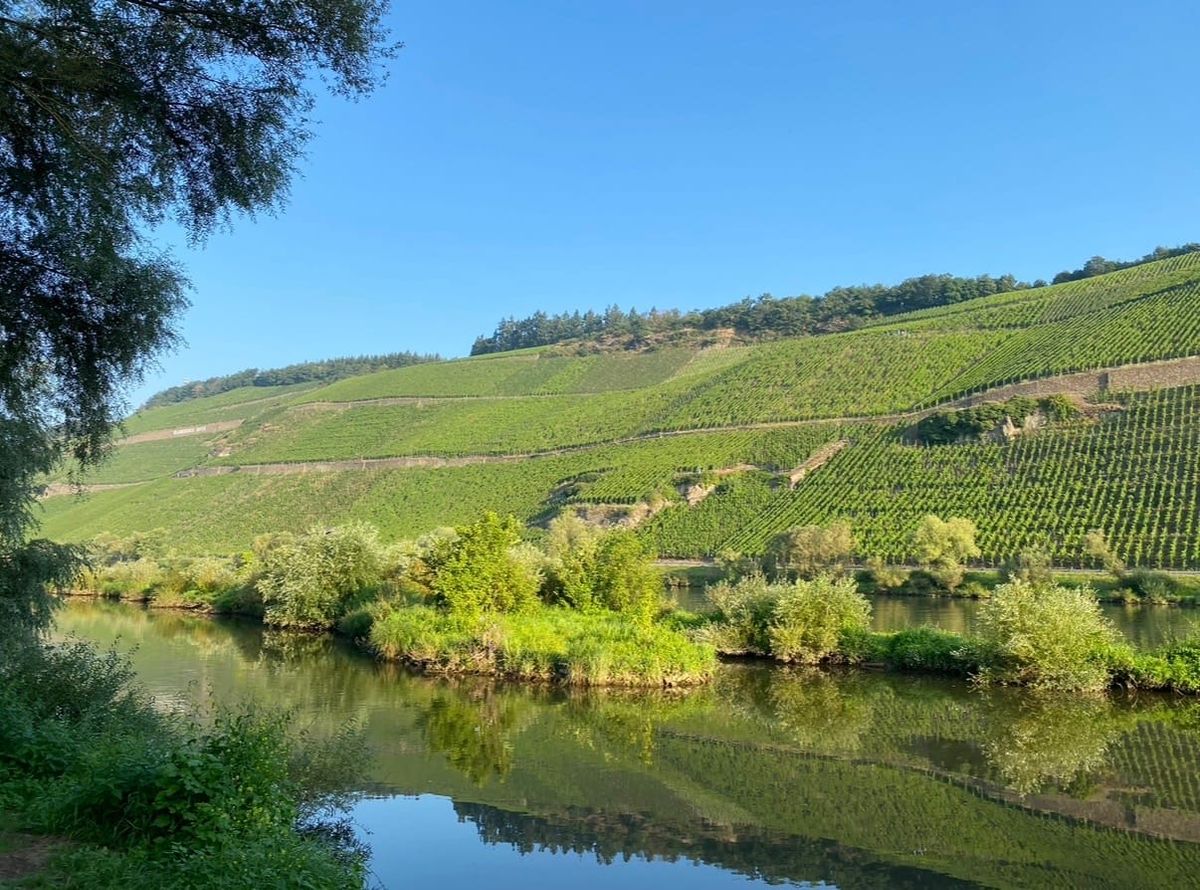
Who doesn’t LOVE the Mosel? Not many people fail to be affected by their first encounter with the twisting valley of the Mosel, the steep sides of which are clothed in vines. No matter what the season is, it’s a dramatic sight that easily etches itself into the memory. And in a uniquely delicate and elegant way, the wines translate this landscape into aromas and flavours that are dramatically different from all other German wines. Indeed, the greatest Mosel wines are totally extraordinary. Perhaps it will surprise somereaders, but this last point is not widely understood, which is why it’s my subject today. No doubt some readers will now say, "Stuart, what about a detailed analysis of the weather during the 2025 growing season and how it shaped what is clearly a great vintage for the region?" Don't worry, I will do some of this, but I think it’s worth pointing out the limitations of that approach.
For example, 2022 was a hot and dry growing season for all of Germany and many of the 2022 dry German Rieslings ended up tasting a bit like Australian wines. Note to those that are not already familiar with Australian dry Rieslings: they are steely, austere and linear, not lush and opulent! However, most of the 2022 Mosel wines retained their characteristic playfulness and subtlety. At the time I jumped at the explanation that the leading Mosel winegrowers had learned from the previous hotand dry years, most importantly 2018 and 2020,which maywell be the case. However, the same is true of their colleagues in, for example, the Nahe and Rheinhessen, but the 2022 vintage wines of those regions tasted strikingly "Australian". 2025 was not like those vintages, although in the early summer it looked like it might go that way. Then, in late July it started raining and the rains that continued through the harvest changed everything.
It’s very difficult to explain how the Mosel is stubbornly different from everywhere else in Germany, but during the four years I lived there I came to appreciate how deeply topography and soil shape both the wines, and the Moselaner, the people of the region. The Mosel Valley feels closed, rarely offering a glimpse of anything beyond the valley. This not only shuts out cold winds, but also makes the outside world seem far away. „Das Tal ist eng!“ or the valley is narrow was the way Ernst Loosen of the Dr. Loosen winery answered my question about the Mosel mentality a quarter of a century ago. He was refering more to the valley in the heads of theMoselaner than the physical one. His words made me realize how many Mosel wine villages are narrow threads of houses pressed between the steep valley side and the riverbank. Here, is surely one cause of Mosel Extremism.
The one thing that the valley and in the hill country above the vineyards - the Eifel to the North and the Hunsrück to the south - have in common is poor soils and the poverty they resulted in. They are consequently all places with long histories of emmigration, and I think that this also is how young people in the region think of it when they move to the nearest urban areas, Cologne. and Düsseldorf. It’s hard for us wine freaks to grasp, but a big chunk of Mosel society has always rejected the region's wines, often due to childhood experiences of being forced to help with the wine harvest. It’s really hard running up and down those steep slopes, and beyond the physical difficulty there is the economic one. „Hier muss Du verdamt hart arbeiten um auf einen grünen Zweig zu kommen!“ here you have to work really hard to get a green shoot, as one Moselaner said to me many years ago; a Painful Mosel Truth.
Another of those is that nowhere in Germany is more threatened by the current crisis of the wine industry than the Mosel, because all the best vineyards are on more or less steep slopes. Although Flurbereinigung, or vineyard reorganization, during the last decades made many locations easier to cultivate than they were before, there's still a bunch of top sites where a great amount of hand work is unavoidable. In extreme cases like the Calmont vineyard site cultivation - probably the steepest in the world - costs can easily top Euro 20 per bottle! The problem is that modern consumers generally only see the label and the price-tag on a website. To them - let’s say it, to us - an exciting GG type wine from the Pfalz for Euro 30 on the shelf looks comparable to one from the Mosel for the same price. However, the Pfalz wine earns the producers a decent profit because almost all the vineyard cultivation was mechanized, while the Mosel wine might be unprofitable if it comes from somewhere like the Calmont. Where is that green shoot now?
Please don’t think that I am being depressive, because I am just trying to realistic. And it is my belief that when the Inspiring Uniquness of Great Mosel Wines is properly appreciated, then they will command prices that makes them profitable. What makes 2025 a great place to start with the Mosel, or to return to the Mosel, is the way the wines are so concentrated and structured, yet retain all the essential qualities of the regioin in asimilarway to great historic vintages like 1937, 1953, 1971 and 1990 did. Perhaps the comparison with 2001 is better, because that was the first modern vintage in which the "traditional" wines with natural grape sweetness and the dry wines shone. The most difference between the two is not that the 2001 wines were sleeker than the 2025s, rather it is the socio-economic context. Sales of 2001 boomed, but those of 2025 are sluggish because of inflation, the various wars being fought around the world and all the anti-alcohol/pro-longevity hyperbole. The depression is not in my head it’s in the market!
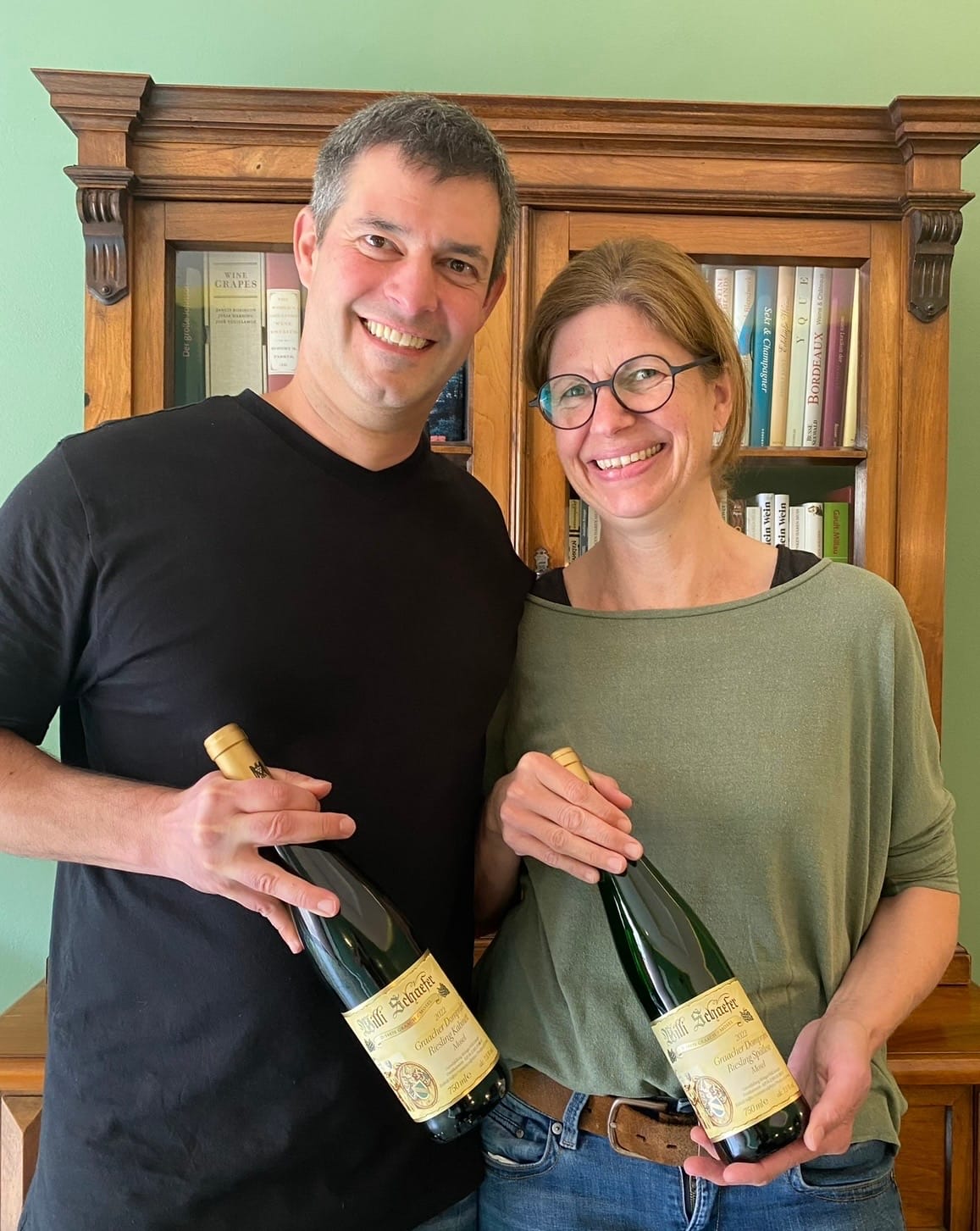
And this brings me to the most important thing about the region: the extremism of the leading winemakers, each of whom has her or his own way of seeing and making great Mosel wines. You might say this kind of diversity is to be found in every winegrowing region, which in a general way is true, but nowhere is it more extreme than here. The E-word tend to provoke the rejection of tthis idea, and many somms have told me it’s ridiculous to talk about people like the Loewen family of Carl Loewen in Leiwen or the Schaefers of Willi Schaefer in Graach as extremists. Sure, they’re not members of extremist political parties, much less terrorists. However, in both cases their sensitivity to Mosel vineyards, vines, grapes and wines is extreme. And in spite of that psycho-cultural similarity their wines are radically different due to the personal preferences, most obviously for Christopher Loewen the main focus is dry wines and for Christoph and Andrea Schaefer off-dry Kabinett and Spätlese is the big thing. And it was the same for the previous generation at each of these estate wineries.
Of course, the extremism of some Mosel winemakers, like Stefan Steinmetz of the Günter Steinmetz winery is palpable to everyone they encounter. For him it is almost abadge of honour that he cultivates some of the most extreme vineyards in the entire valley. He relishes the fact that he has to walk through dense woodland to reach the pathway down to one of his vineyards from above! Here what is consciously or unconsciously hidden in some of his colleagues becomes glaringly obvious. And his amazing 2024 dry Rieslings show what this kind of extreme dedication to the vineyards nobody else wanted make possible.
Just a 90 minute drive away from all this in Rheinhessen the winemakers operate in a way that's an order of magnitude more pragmatic. That doesn’t mean that the vineyard cultivation and winemaking are any less good, but the way goals are set, then defined is very different from the Mosel, also because the entire undertaking is inherently far less taxing in the physical and financial senses. A leading Rheinhessen winegrower has both feet on the ground most of the time, whereas in the Mosel mostly only one foot is on the ground. Believe it or not, I got this comparison from snooker, a billiard/pool-like game for which the rules say that the player is allowed to twist and stretch their body as much as they like to make a shot, but must always keep one foot flat on the ground. This is how I see a leading Mosel winegrower in a challenging situation, and the truth is that the situation is always more or less challenging. Stuart Pigott's Law of Mosel Wine states:
No hard work plus no extremism equals No exciting Mosel wine!
MODESTLY PRICED INTRODUCTIONS TO MOSEL EXTREMISM
Ansgar Clüsserath Mosel Riesling Trittenheimer Apotheke Kabinett 2025 - 8.5% / A tapestry woven from wild berries, white peach and roses! Stunning elegance and slaty minerality on the very focused and pointed palate. Spot-on balance at the brilliant finish. 95 (SP)
Carl Loewen Mosel Riesling Varidor 2025 - 12% / Gold can be delicate as this proves, and there’s a delicate touch of herbal freshness that brightens this in the nose. Terrific racy minerality for a wine from unspectacular vineyard. Very long with excellent tension and complexity. This dry wine from 20 plus year old vines from a massale selection is great value for money. 93 (SP)
Max Ferd. Richter Mosel Riesling Wehlener Sonnenuhr Kabinett 2025 - 8% / Step into this fabulous florists store in Midtown Mosel and forget all your troubles! If you’ve got an open mind, then the balance of this super-elegant beauty is spot on! Very long silky finish that caresses you in the most delightful manner! 95 (SP)
Günther Steinmetz Mosel Riesling Wintricher Geierslay GW 2024 - 13% / An excellent argument for the greatness of this still quite unknown site in the Middle Mosel. Remarkable ripeness for the vintage - melons! - but with its typical coolness too. Ample body and structure plus aromas of Mandarin orange, basil and tarragon give this a very strong character. 96 (SP)
NOTE: Only for paying subscribers the notes for all 135 wines tasted can be found below. The ratings include one wine with 100 and five with 99!