MOSEL NOW Part 2: The Sweet Spot
Is it the Riesling G-Spot?
Text by Stuart Pigott and tasting notes by Frank Ebbinghaus & Stuart Pigott -
last revision 07.10.26
NOTE: This is not a complete survey of this section of the Middle Mosel, since a number of important producers are missing. The tasting notes for Dr. Loosen will appear with the forthcoming potrtrait of Ernst Loosen, and the wines of Markus Molitor will be tasted in November, along with several producers in the Traben-Trarbach area.
When I began getting professionally involved with wine in the early 1980s some people in the London wine scene said that the stretch of the Mosel from Bernkastel downstream to Zeltingen was the real Middle Mosel, while others more cautiously claimed this was the „Heart of the Middle Mosel“, and often stretched stretched its borders. I first made it to the Saar in September 1982, almost 18 before I got to the Mittel Mosel. Although the Saar remains an island of sweet Riesling wine production, this section of the region remains the Mosel Sweet Spot: the stretch of the valley where there is the most significant production of high-end Kabinett, Spätlese and Auslese Rieslings with natural grape sweetness (see below for an explanation of this term).
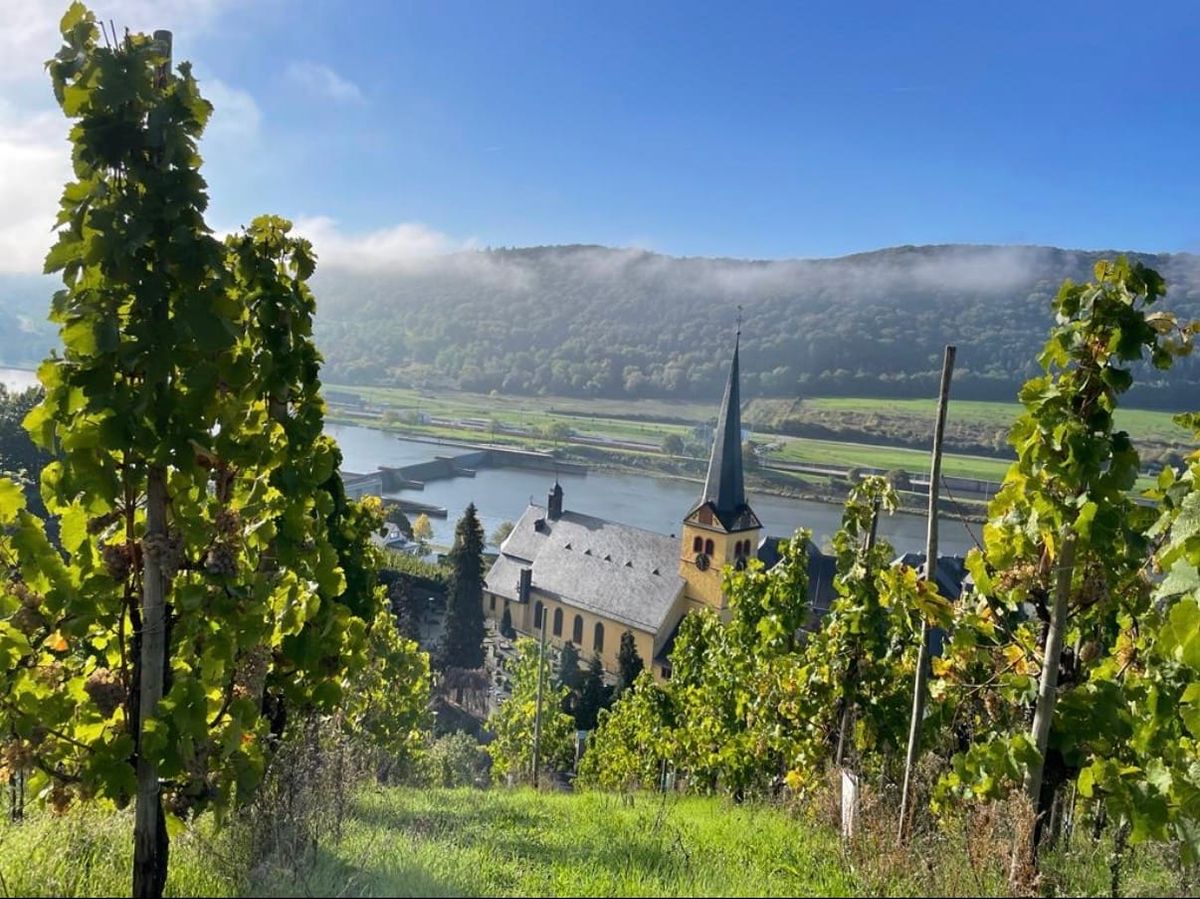
And, although the producers here face serious competetion in this field from some of their colleagues further upstream (see Part 1), a good part of those wines also come from vineyards here, most notably the Doctor, Graben and Lay of Bernkastel, the Himmelreich and Domprobst of Graach, the Sonnenuhrs of Wehlen and Zeltingen. These famous sites belong to one of the longest contiguous strips of vineyards in Europe. The best view of this is from the Burg, or runied castle, of Bernkastel. From here it has a dramatic, sweeping beauty. However, the wines from here stand out because of their delicacy and filigree. That is most striking in the wines with natural grape sweetness, but even the more powerful dry wines retain a good deal of this, and that’s also what makes them stand out.
The really striking thing is how the fundamental personality of the wines hasn’t changed since I tasted the young wines of the excellent 1983 vintage back in April1984. What has changed, and radically so, is the disappearance of the once frequent poor vintages like 1974, '77, '78, '80 and '84. In those years the top vineyard sites with their steep slopes facing south to southwest and dark slate soils were the only places that wines with some character and balance could be made. (There are good scientific explanations for why these locations have a great advantage over the flat vineyards or north-facing slopes). Of course, it is global warming that caused the massive change. After 2003, when the seriousness of this warming become crushingly obvious, it was frequently claimed that the top vineyards of the Mosel had lost their primacy, because you could ripen Riesling everywhere in the valley. The latter point is true, but the wines of the top sites still stand out in spite of this fact. As Ernst Loosen recently said to me, „we used to need the top sites to get the ripeness, now we need them for the finesse.“
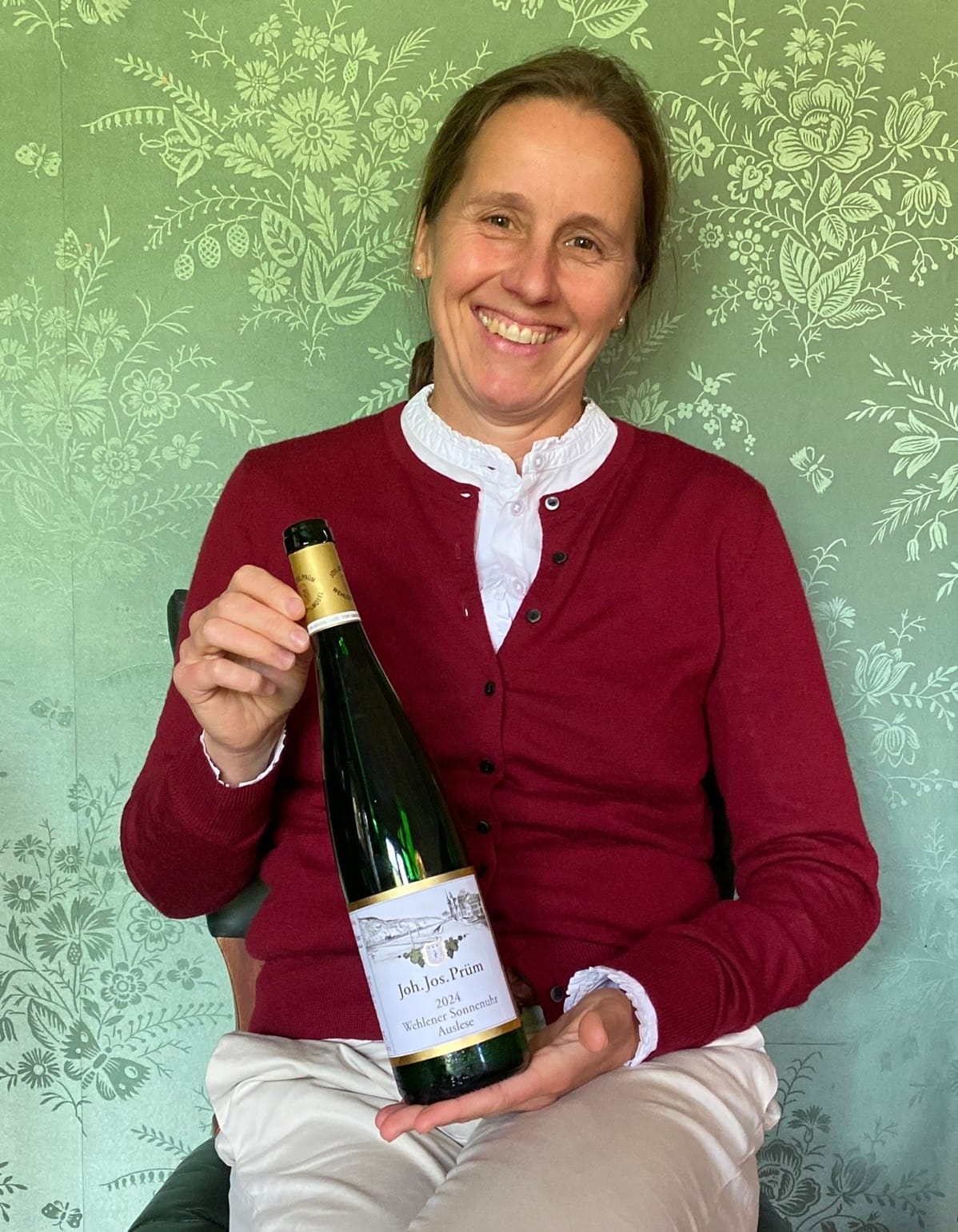
That word is vital to describing the 2025 vintage here, that combines excellent ripeness and vitality with great finesse. How good are these wines? Well, they're certainly a match for great „classic“ vintages like 1990 and 2021, although they had more prominent (and sometimes even pointed) acidity than 2025 has. The best words I can find to describe the acidity of 2025 is brilliant and polished. The 2025 wines of Joh. Jos. Prüm in Wehlen possess all the positive qualities of the 2025 vintage to the highest degree. I've had dozens of exciting tastings of young wines at this famous winery, but what Katherina Prüm presented me with put them all in the shade. And the Bernkasteler Badstube Kabinett 2025 offers the chance to buy a great wine from this producer for a moderate price.
The wines of Willi Schaefer are much more difficult to purchase (please note that everything is sold out at the winery!) because of the small size of this producer and the enormous international demand for the wines, but the balance of intensity and delicacy here is extraordinary in 2025. If you are looking for delicacy that approaches the impression of weightlessness, then that's what Wwe. Dr. H. Thanisch, Erben Thanisch (VDP) achieved in 2025. Then comes the huge range of wines from Selbach-Oster plus the micro-estate of Alfred Merkelbach with just 1.5 hectares of vineyards in Ürzig and Kinheim that’s owned by Johannes Selbach. A few of these have both feet firmly on the ground of price points in export markets, but there’s also a wealth of great dry, naturally sweet and nobly sweet Rieslings. Fully 18 wines rated 95 point or higher. Whoa!
Something notalways understood is the central importance of "wild fermentation" for the naturally sweet wines of the Mosel. Almost all of those below were wild-fermented, and for dry wines at least the first half of the fermentation is wild,and that's when the great majority of the aromas develope. (Ambient yeast is the correct scientific term). I think it is fair to claim that the yeast cultures reponsible for this are particular to the region and play an important role in giving the wines their special aromatic profile, also some aspects of their mouthfeel. The natural sweetness is retained by stopping the fermentation, and here sulfites play a vital role. Of course, the natural wine scene has demonized sulfites, although alcohol is actually the main poison in wine! Adding sulfites might sound brutal to purists, but with "wild" yeast doing the work fermentations tend to be sluggish, and the cold of the cellar also pulls the brakes on. So, usually, it's rather easy to stop fermentations like this. And at alcoholic degrees between 7.5% and 9.5% there’s much less of that "poison" in the finished wine than say a 15% alcohol Napa Cab or Châteauneuf-du-Pape!
Finally, a few words on the 2024 vintage, which has been frequently referred to by winemakers, somms, critics and consumers as a cool vintage. Although the harvest period was rather cool the AVGST (Average Growing Season Temperature) for 2024 was slightly higher than for 2003, which at the time was christened the "Summer of the Century". The 2024 wines somewhat resemble those of the good vintages of the 1990s, but back then with significantly less heat the acidity of the wines was sharper. Yes, the 2024s are lighter in body and structure than the 2025s, but they have a pleasantly crisp acidity, that's rarely aggressive.
WELCOME TO THE MOSEL SWEET SPOT!
Joh. Jos. Prüm Mosel Riesling Bernkasteler Badstube Kabinett 2025 - ??% / A whole garden of herbs in the youthful nose! On the sleek palate like a crystal clear stream charging down the side of a mountain. Super-cool in every sense of those words! Yes, there's some grape sweetness, but it is really subtle. Cask sample. 95? (SP)
Willi Schaefer Mosel Riesling Graacher feinherb 2025 - 10.5% / Just an off-dry village wine, but it's stunningly expressive with a wealth of spring meadow and wild flower aromas. Spot on balance of juicy white tree fruit flavours with morning dew freshness. Long, super-elegant finish. 94 (SP)
Selbach-Oster Mosel Riesling Zeltinger Schlossberg Spätlese 2025 - 8.5% / Nobody thinks of drama when it comes to Spätlese, but this is a Gone with the Wind wine that blasts away the cobwebs with its peachy intensity and wet-stone freshness. Very long, clean finish. 95 (SP)
NOTE: Only for paying subscribers the notes for all 97 wines tasted are below. They include two wines with 100 and four with 99!