RHEINHESSEN NOW Part 1: Does it get better than this?
Searching for and Finding Beauty
By Stuart Pigott - last revision: 21.09.26
NOTE: The long version of this report for paying subscribers has more than 100 tasting notes in it, but that is certainly not the complete picture. Because the 2026 harvest started so early I didn'tmanage to taste the wines of a number of important producers in the Wonnegau and Nierstein-Nackenheim in time. These gaps will be filled, and a separate report devoted to the wines from Weedenborn (including a vertical tasting of Sauvignon Blancs) will also be published...
"2025 was clearly the smallest vintage in terms of quantity that we ever harvested," Felix Keller of the Keller winery in Flörsheim-Dalsheim told me, "the sugar ripening of the grapes went crazy fast!" Then, his father added, "but all the dry Rieslings have 12.5% alcohol on the label, except the Abtserde GG which has 13%." This combination told me they had run to get all the grapes in as soon as they were ripe.
"During the harvest I had the feeling that we were always three days too late, and the wines would be too big," Philipp Witmann of the Wittmann winery in Westhofen said to me, "however, after fermentation the highest alcohol levels were 13% - 13.1%. So, without realizing it I was exactly right!" Philipp is a very precise winemaker, but even he was flying blind in the lightning-fast 2025 harvest.
Of course, not everybody made the same call. Fritz Groebe, of the Groebe winery also in Westhofen frankly admitted to me, "we had full ripeness and higher alcoholic content than the previous vintages, but very well integrated, the wines have great minerality and are so animating!" Later, he compared the vintage with the great 1953, which is high praise.
And there, with just three voices, each heard briefly, you have the most important aspects of the 2025 harvest in the Wonnegau sub-region of Rheinhessen where many of the most sought-after dry German Rieslings grow. This is the first of two stories about Rheinhessen, focusing on the Wonnegau and the Nierstein-Nackenheim area, which is already a contrast, since limestone is the dominant bedrock in the former and Rotliegenden (sometimes referred to as red slate, although it is actually only slate-like in appearance) in the latter.
Some wine producers and wine freaks may scream when they read this, but I think it is fair to say that one reason the Wonnegau has done so well since 2015 is that it's generally clay-rich soils have good water-retention, while the much less water-retentive soils of Nierstein-Nackenheim have made the wines more erratic in quality. Hotter and drier summers since 2015 are more of a challenge for the vines where water reserves in the soil are scarce. This is the New Rheinhessen Normal.
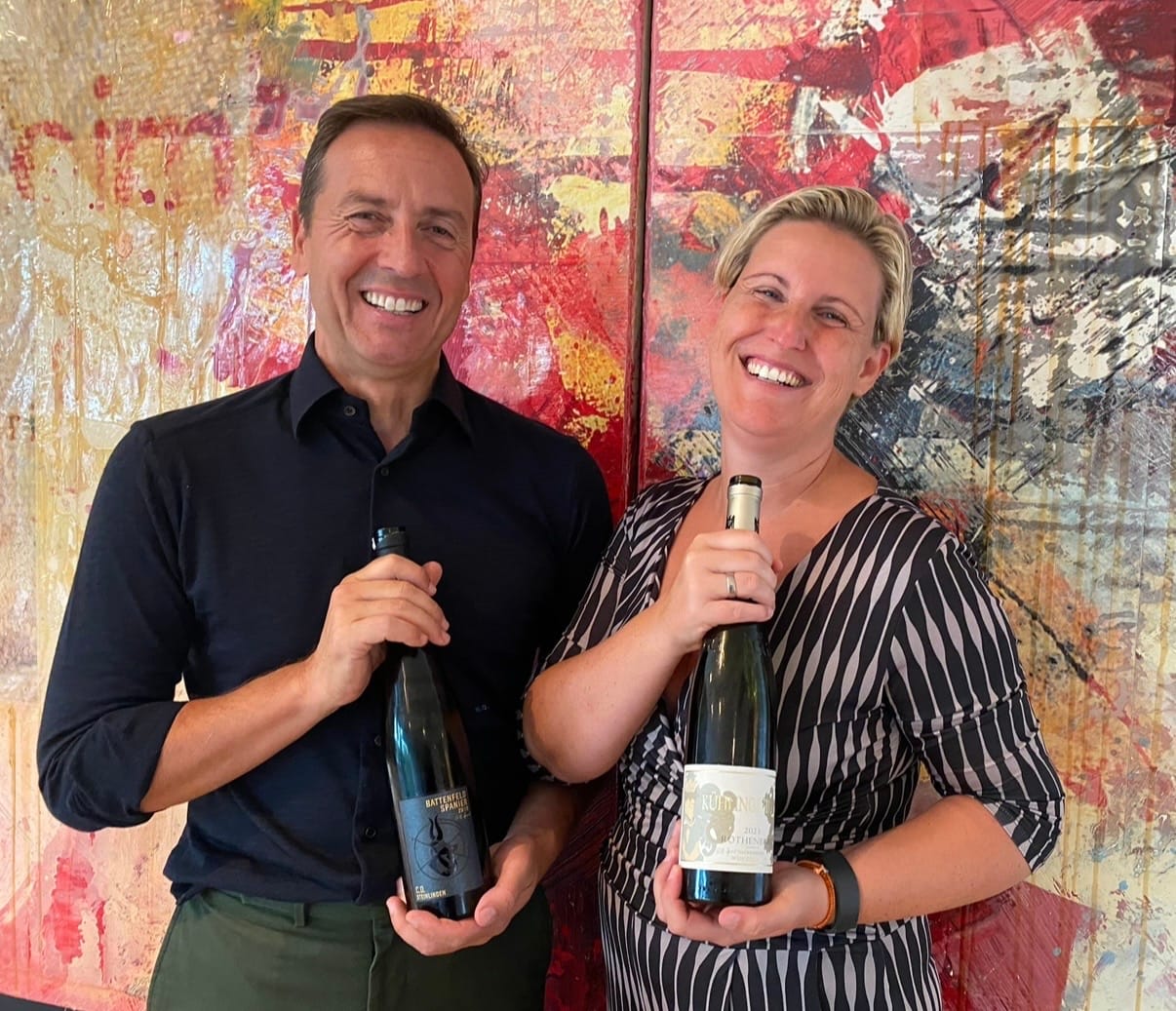
Of course, weather data and new climatic patterns due to global warming are one thing and wine in the glass is another. Over the last couple of months as I tasted my way through Rheinhessen I was struck again and again by how well the leading winemakers have adapted to the new conditions. Nowhere was this more striking than at the husband and wife double act of Battenfeld-Spanier (he being H.O. Spanier) & Kühling-Gillot (she being Carolin Gillot). This year they celebrated their 20th anniversary of winemaking together with an amazing range of Riesling GGs. Here you have the opportunity to compare wines from the Wonnegau (Battenfeld-Spanier) and the Nierstein-Nackenheim area (Kühling-Gillot) made by the same team in the same cellar with the same unwavering commitment to top quality. It offers cast iron proof that nowhere on Planet Wine is there a single Holy Terroir that's inherently superior to all the rest, rather each important vineyard location has its own set of advantages and disadvantages. The art is to master the latter, and this double act has done that for all their top sites.
The other great husband and wife team in this part of Rheinhessen are much newer. I thought Katharina Wechsler of Westhofen might never marry, then along came Manuel and both their lives abruptly changed. Katharina is now an "old hand", having learned at Keller and the first winesshe sent me were from the 2009 vintage. In contrast, Manuel is still new to the business with the fresh perspective of an outsider who looks at winemaking from the outside. Here, a reorientation just happened, production of the range of cloudy "natural" wines having ceased. On the other hand Spätburgunder aka Pinot Noir reds are now clearly the second focus alongside dry Riesling. It was at this tasting - on the first hectic day of the 2026 harvest - that the quality of the 2024 Spätburgunder/Pinot Noirs in Rheinhessen really hit me. The region is making a serious statement in this category, and nowdeserves as much attention for them as say the Pfalz.
Now it's time to return to the trio of producers we began with. Fritz Groebe may laugh or blush when I say that he's one of the Grand Seigneurs of Wonnegau winemaking, but for me this is obvious. Nowhere is it more obvious than in the stunning row of nobly sweet Riesling Auslese Fritz made in 2025. Due to the ample Botrytis at the end of September and the beginning of October 2025 it was relatively easy to make Riesling Auslese, and I tasted a bunch of very good wine. However, none compared to Fritz's. Sometimes there's no substitute for loving a wine style, even if you can rather seldom make it.
There's no doubt in my mind that Philipp Wittmann's 2025 vintage dry Rieslings are the best wines he ever made, and that's saying something, because 2023, 2019, 2018 and 2007 were all fantastic vintages for Wittmann! They are the product of still youthful energy meeting the wealth of experience he gained since taking over the winemaking with the 1998 vintage. And that's really what the wines taste like: so crisp and energetic, yet also deep and wonderfully mysterious. They also show how crucial the human element is, regardless how great the vineyard site or the vintage are. Without the winemaker's mind, heart, senses and hand there is never any great wine.
And finally, there are the wines from the Keller family. Sometimes it's not easy to tastes these wines through all the myths that have grown up around Klaus Peter and Julia Keller. These myths can be as thick as the London fog in early 1960s movies, and that fog has itself been a myth for decades! But my job is not to assess myths, it's to taste wine in the glass with an open mind, and to try to understand in a realistic manner. And so, on the 7th July I sat with Klaus Peter, Felix and a colleague at at able in Keller cellar and I put everything else out of my mind.
The truth is that not every Keller wine is automatically mind blowing, because wine is affected by so many variables and not every vintage equally suits every vineyard site, but an extraordinary perfectionism lies behind every Keller wine. After the tasting my most important observation is that the 2025 dry Rieslings, along with the 2024 Chardonnays and Pinot Noirs, plus the new sparkling wine offer a wealth of beauty. Often young winemakers ask me what I look for in wines and my answer is the same as when they ask me what makes the Keller wines so special: beauty.
In 2026 in Germany, just as in most other places around the globe, beauty is currently in short supply, whereas cynicism, anger and hatred seem to be available in horrendous abundance. I recommend you reject those things and look for beauty in Rheinhessen, at Keller and at the wineries of all their excellent colleagues!
BEGIN YOUR SEARCH FOR RHEINHESSEN BEAUTY HERE
Kühling-Gillot Rheinhessen Riesling Nierstein trocken 2025 - 12.5% / Brimming with peach, pear, wild herbs and leesy complexity this is a great village wine! Very firmly structured with a dense mineral core, but not a gram of fat, it’s a radical expression of Nierstein with enormous aging potential. 95 (SP)
Groebe Rheinhessen Riesling Kirchspiel Auslese 2025 - 8.5% / Sings a hymn of joy to nobly sweet Riesling! A giant mouthful of fresh pineapple, mango and super-ripe yellow peach, this is caressingly seductive. Almost perfect balance at the long and very succulent finish. 96 (SP)
K. Wechsler Rheinhessen Riesling Westhofener trocken 2025 - 13% / If you’re looking for an exciting dry Riesling with GG-type stature and a serious depth of limestone character then here it is. Deep and subtle yellow plum fruit is married to quite some textural complexity on the compact yet fresh palate. Long, complete finish. A cuvée of wines from the Kirchspiel GG site with a small amount from Morstein. 94 (SP)
NOTE: Only for paying subscribers the notes for all 108 wines tasted can be found below. The ratings include two wines with 100 and seven with 99!