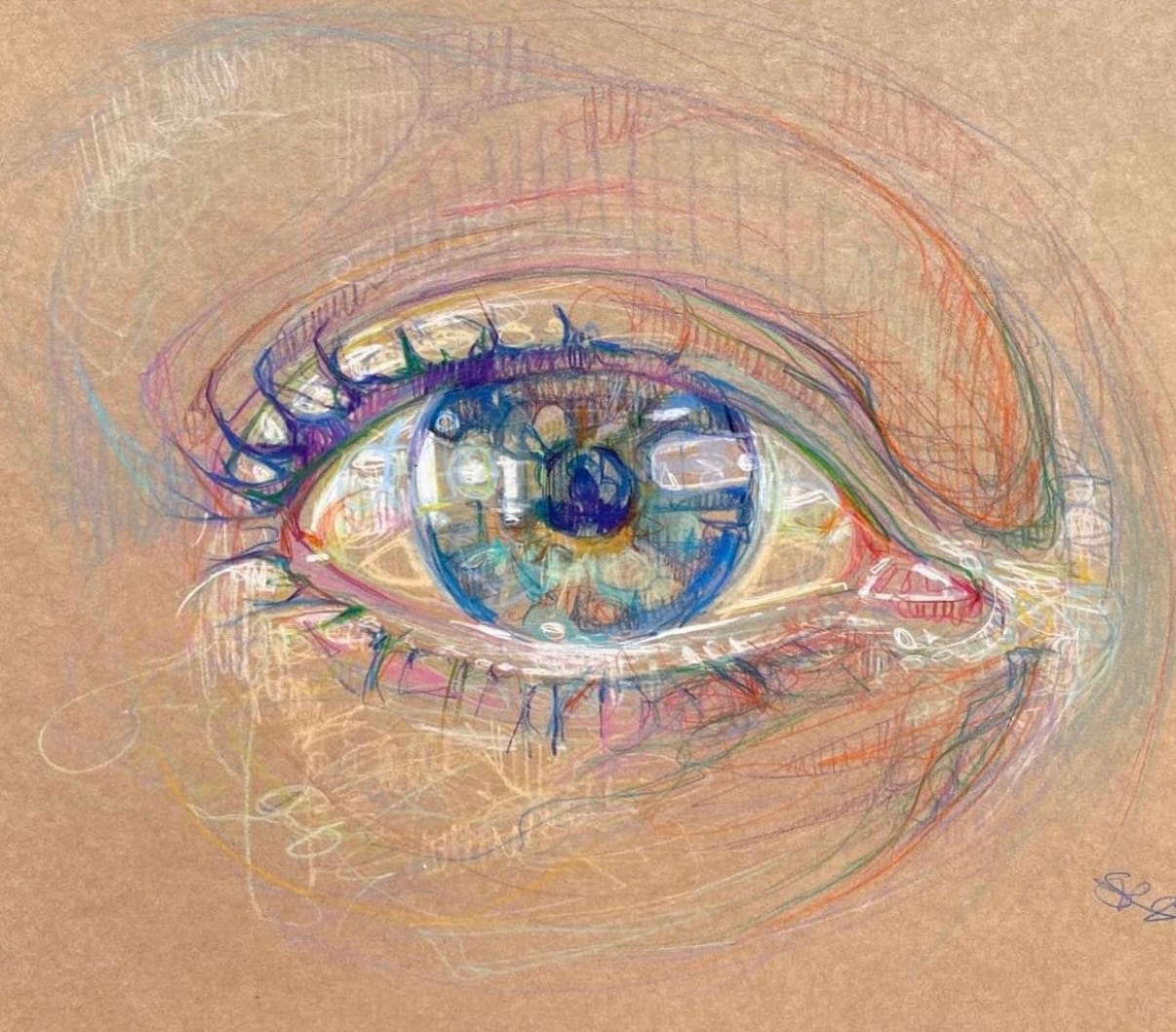
SANDRO KOPP'S EYES
Looking at a unique artist's work
By Stuart Pigott - last revision: 22.10.26
The main focus of this website is wine, but from time to time other subjects will demand coverage. This is the first such story.
“If only you could see what I’ve seen with your eyes!” Roy Batty, a Nexus-6 replicant or android, tells the genetic engineer Hannibal Chew near the beginning of Ridley Scott’s 1982 sci-fi movie Bladerunner. It sounds so beautiful isolated from its context, but actually Batty is threatening Chew. That moment in Bladerunner reminds me of Sandro Kopp’s drawings and paintings of eyes, but only in the poetic sense of those words. There’s nothing threatening about Sandro’s images, but there’s certainly a mystery to them.
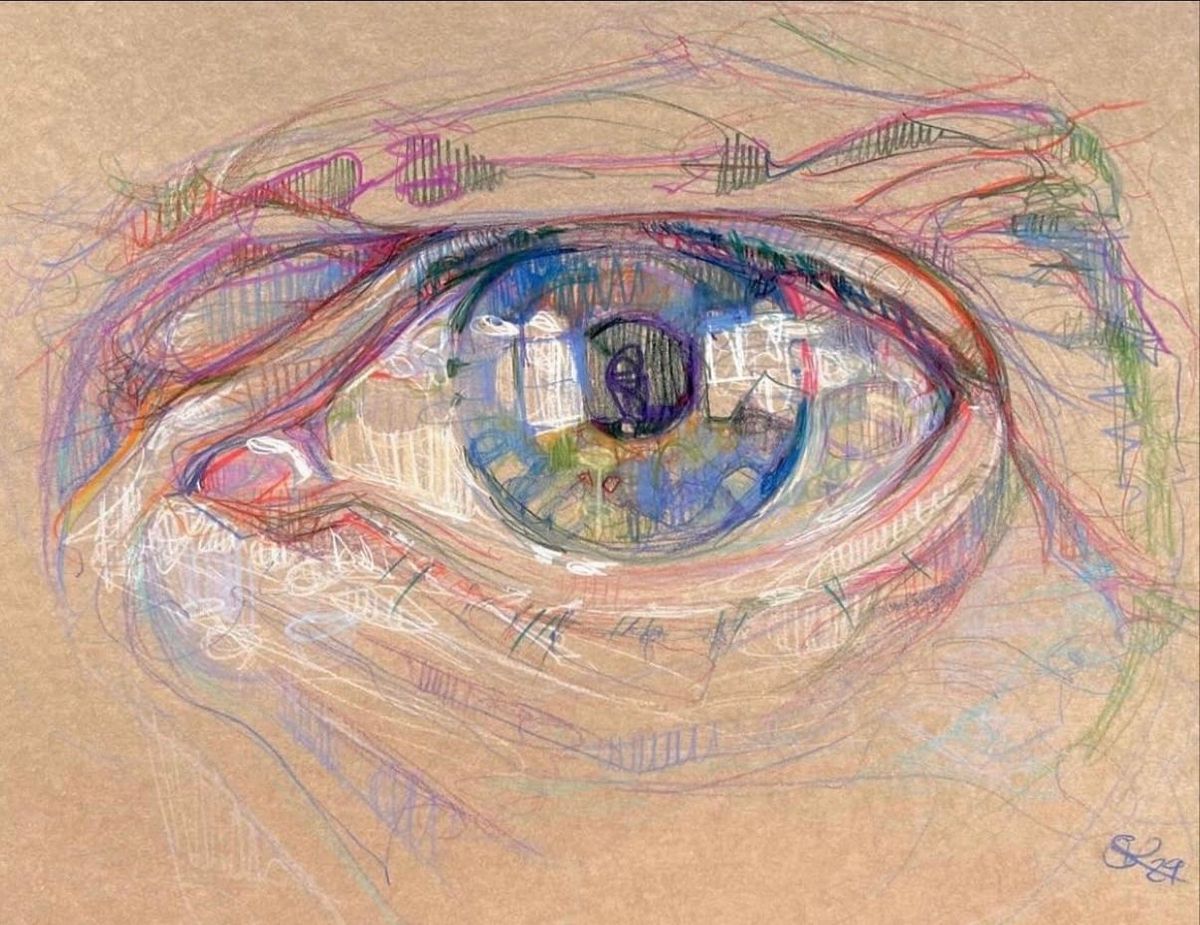
Sandro Kopp’s drawings of my left eye and my wife’s right eye hang on the wall of our apartment, one above the other. Standing right in front of them and gazing intently at one of them is a bit like being in a movie theatre when suddenly a giant image of an eye fills the entire screen, as is it does during the opening sequence of Bladerunner. For my wife and I the difference between these two situations lies in how specific our experience is: my eye seems fixed upon me, and for my wife her own eye seems fixed upon her; each of us meets ourself.
When I look intently at Sandro’s image of my eye firstly, I see the pattern of the iris and of the light reflected by the surface of my eyeball, then I see something in the image that appears to flicker. Of course, it’s actaully a flat drawing - intricately woven coloured lines on buff-coloured paper - and I see that too. What I never find in this image is any perspective, because it pushes me right up close to my eye so there’s almost no sense of spatial depth; a universe with two dimensions plus a little bit that’s barely there. And yet we talk about looking someone in the eye, as if an entire other spatial dimension might reside there.
I first saw Sandro’s work in the house of Olivier and Margaret Humbrecht, the owners of Domaine Zind-Humbrecht, one of the leading wine producers of Alsace/France. As Olivier showed me Sandro’s paintings of their eyes and those of his parents, I realized just how much time we all spend looking at other people’s eyes, as well as looking at our own eyes in mirrors. But, as important as these intimate exchanges of visual signals are, we rarely reflect upon this key human experience that’s fundmental to media as diverse as portrait photos and selfies, magazine advertising, feature length movies and brief video clips.
Normally, our eyes are in near-constant motion, probing our surroundings and checking on ourselves. Think of the final glance in the mirror before you leave home. Many people can’t leave home without it. From an evolutionary point of view our eyes seek food to gather, prey to persue and predators to flee; things we share with countless other animals. It’s a special situation when a pair of human eyes stares intently at another person or object, no less so when they stare blankly into the distance. How crucial those ways of looking are for the visual and performing arts, and on many levels!
Sandro paints and draws eyes that seem to stare into some undetermined distance, but when I look at one of them for long enough, then the flickering I described suggests motion, as if the eye were probing me. But how can it do that when it’s actually a knot of coloured lines? Although they are very precisely drawn, what results is something much more than a realistic likeness a single eye in all its detail. During the obsessive process of intertwining those lines into peaceful maelstroms of colour something beyond mere representation slips into them, and it’s that which holds my gaze.
It’s certainly not the soul of the sitter Sandro captures. The idea that the eyes are the windows to the soul is no more than a seductive metaphor, although it says something about the compelling power of the eyes. Rather, I think it’s some aspect of the subject’s gaze that Sandro grasps. When I look at his drawing of my left eye intently I don’t just examine all the details of my eye and the things reflected in it, I encounter something of my own gaze. And so, without the aid of an analogue or virtual mirror, I exchange visual signals with myself, catching some of what I project outward into the world with my eyes.
Our cat just died, and when I found her body one of the things that told me she was dead was the emptiness of her eyes. That her gaze had vanished was a sure sign she’d passed away. What a contrast to Sandro’s images of eyes! When I look at one of them for long enough I'm sucked into it and feel it gazing back into me; a unique artistic expression of a key human experience.