THE MOSEL NOW: Riesling Light in Our Darkness
Great Now News!
By Stuart Pigott - last revision: 10.08.26
This is the first in a series of stories about the Mosel focused on the wines of the 2025, 2024 and 2023 vintages, aka Wines You Can Actually Buy. As I was dividing the mass of material into bite size pieces I suddenly saw that in very different ways two producers based slightly downstream from the central section of the region both went back to 1991, and relaized that this has is the thread connecting Martin Müllen in Traben-Trarbach and Immich-Batterieberg in Einkirch.
What actually happened 35 years ago, back in 1991?
At the time the dissolution of the Soviet Union, which lead to the end of the Cold War between NATO and the Warsaw Pact countires, was a Big Deal for me. You see, I grew up during that period with the constant threat of nuclear war and the end of Civilsation As We Know It. From my birth in 1960 to 1991 I lived close to major targets and would certainly have died if the Cold War had suddenly turned HOT, as it almost did in November 1983 (see the Wikipedia entry for Able Archer 83). Less obvious at the time was the fact that, theoretically, the World Wide Web become open to all in 1991. Within a couple of years Internet Euphoria - the belief that the Internet would change everything for the better - had become a widespread delusion. Of course, the world didn’t fundamentally change for the better, as subsequent events prove, but 1991 was a turning point for the Mosel.
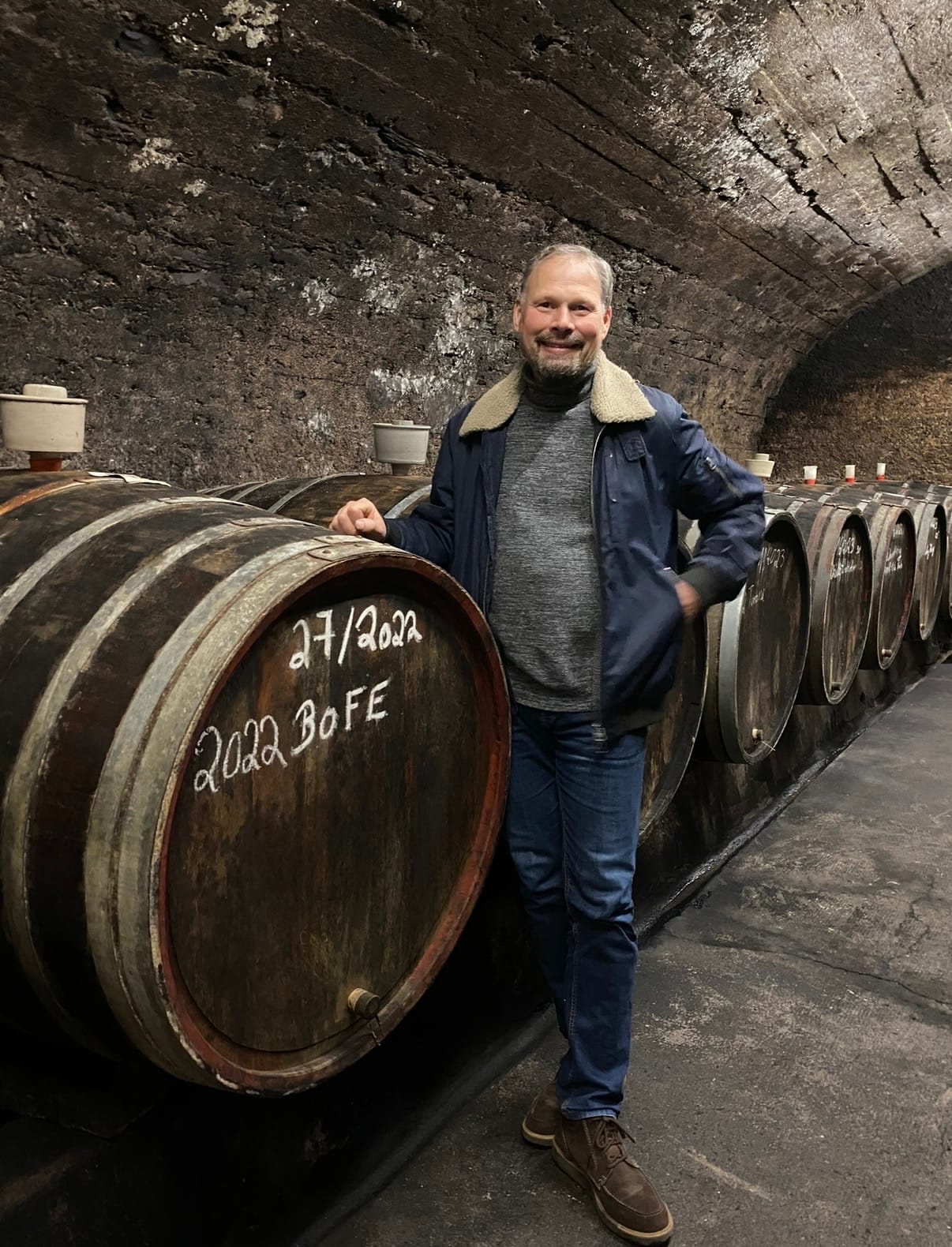
MARTIN MÜLLEN
Martin Müllen had been making a small amount of winein Traben-Trarbach for five years, twhen in 1991 he turned professional. A new small producer might seem like an unspectacular development in a large wine region like the Mosel, but the foundation of a new winery was an extremely rare occurence and a new winery dedicated to top quality was unheard of. It established the principle that this was an entirely feasible option, which was a Mosel Paradigm Shift.
You don’t need to be Albert Einstein to realize that no winery can go from Zero to One Hundred in its founding year. In 1994 Müllen acquired an old Korbkelter or basket press, and to this day he processes all this grapes using basket presses. The combination of this, Spontangärung aka wild fermentation, and working almost exclusively with the 1,000 liter Fuder casks tradtionalfor the region are the key points of the Müllen family’s winemaking. (No less important is their precise hand work in the vineyards). Of course, they have some modern machinery, but the way they are working is not fundamentally different to how Mosel Rieslings were being made back in the early years of the 20th century; the region’s modern high point. Theirs is a Seriously Retro approach.
Then, in 2000 they were able to purchase a 0.35 hectare parcel of vineyard in the Hühnerberg site of Trarbach, situated in the Kautenbachtal, a tributary valley of the Mosel. Most of the vines hadn’t been cultivated properly for years, but the Müllens managed to save about 70% of them, vines ranging in age between 40 and 100 years old. Back then it was unheard of to purchase land in a forgotten top sitein an Off Locatiion, but the Müllens weren't alone. Daniel Vollenweider bought land in the Goldgrube site of Wolf the same year. This was another Mosel Paradigm Shift.
Today, the Hühnerberg is undoubtedly the Müllens top site, giving wines that are extremely racy with intense slaty minerality and wildly floral aromas. For no other wines of any grape variety or location have I frequently written „hyachinth“ as a wine dscriptor! The Müllens are not only dedicated to making great wines - across the whole Mosel range, from light, medium-bodied and powerful, and of every shade from bone dry to nobly sweet - they are also dedicated to making UNIQUE WINES. Only an occasional entry level wines don't quite make it into this category.
The newest phase of this story is how Martin and Susanne Müllen’s son Jonas not only grew up, but also grew into their philosophy and made it his own. Seeing this they decided to purchase a spacious old cellar in Trarbach that had long been disused. The Müllens put in a new floor in the cask cellar to make it easier for them to work there - a much bigger and more expensive job than it sounds - and from the 2022 vintage all their wines have been made here.
For more information visit: www.muellen.de
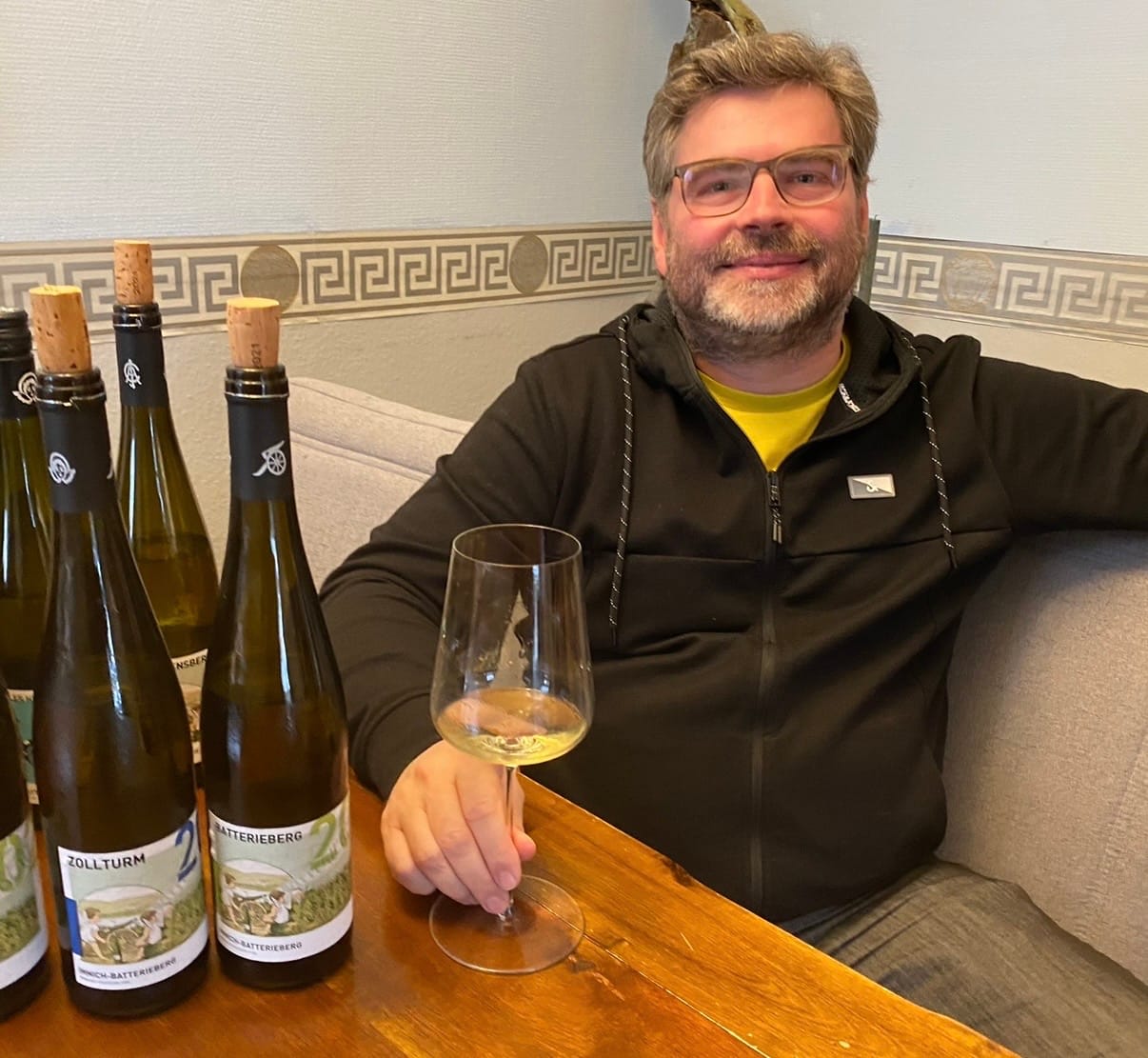
IMMICH-BATTERIEBERG
The recorded history of this estate winery in Enkirch on the Mosel goes back to 908. Yes, 908, not 1908! Please visit the website www.batterieberg.com if you are interested in the Backstory, but all this has nothing to do with the events of 1991.
In the autumn of 1991 Gernot Kollmann began a stage at the Dr.Loosen estate in Bernkastel on the Mosel, where I lived at the time. I was short of money and therefore very glad when Ernst Loosen asked me if his stagist could share my flatand the rent. In this way we got to know each other rather well. I have often been criticized for being friends with winemakers like Gernot and the question, „where is the crtitical distance?“ has often been thrown at me, sometimes with an accusing tone. My answer always been that it is mistake to think that physical distance somehow creates critical distance. The truth is that critical distance is a form of self-discipline that is all in the mind.
Anyway, Gernot was the first young person from a non-wine background - he was from Wetter in Westfalia, a beer region - to study winemaking in this country. That's a German ParadigmShift. He did so in Heilbronn, graduating in March 1997, then worked for a number of wineries. Then, after some years running his own winemaking consultancy, Gernot moved to Immich-Batterieberg in 2009 after it changed hands yet. His first vintages there were good, but they were also experimantal, as he started fermenting and maturing dry Mosel Rieslings in well-used Barrique casks of 225-300 liters that are almost neutral in flavour. (This applies to all the single-vineyard wines and the Escheburg cuvée. Entry-level wines are made in stainless steel tanks). Having lost my older Immich-Batterieberg wines in an accident it is difficult for me to place the vintage with which the wines took a leap forward, but it recent years they have often been stunning, and the very best of them are spectacularly original.
Reinventing the wines of a „classic“ wine region like the Mosel is no easy task, and if you or I decided we wanted to do that it would take us many years, and there would be no guarantee of success. That's because this task is completely different from that of making very good wines in a well-established style. This can be learned and, assuming you are dilligent and do things precisely, you will more or less succeed. On the other hand, stylistic originality is NOT an apple that grows on a tree and one day falls on your head, rather it is a long and winding road that's often also steep and stony. For Gernot, all the years of working for other peroducers weren’t just about making money, they were also a process of clarifying his own ideas. During his first years at Immich-Batterieberg he adapted what he had learnt to the special situation of the vineyards of Enkirch, then, suddenly they were UNIQUE WINES.
In winemaking almost nothing goes entirely to plan, but if you do a great job and keep an open mind you might well discover some extraordinary things. That was certainly the case for Gernot. When he arrived at Immich-Batterieberg he picked up the traditional internal hierarchy of vineyard sites at this producer with the monopole Batterieberg site at the top. In its present form that site was created during the 1840s by the use batteries of explosives to remove some of the small cliffs in this site to make its cultivation easier. There’s no denying that these powerful and structured wines are something special, but Gernot discovered that the over 100 year old vines in part of the Zeppwingert site could give wines that are as extraordinary and possibly more fascinating, and he embraced that.
CODA
I remember my sense of relief around Christmas 1991 listening to the announcement of the dissolution of the Soviet Union on the radio (BBC world Service), because it meant that the nuclear confrontation of the superpowers had ended. Back then, I certainly didn’t think that the sensitive and thoughtful young man I was sharing my flat with would one day reinvent Mosel wine, but today it is clear that Gernot Kollmann has done exactly that! And I didn’t even know Martin Müllen yet, so I wouldn't have been able to say anything about him, except that new wineries on the Mosel was an absurd idea.
The only problem with looking back to that moment of hope is the comparison between the Then News and the Now News. The News Now is filled with the same shadows that the whole world lived in during the Cold War. This means that the wines from these two extraordinary producers are Riesling Light in Our Darkness. We need them!
A TASTE OF RIESLING LIGHT
Immich-Batterieberg Mosel Riesling Zeppwingert 2024 - 12.5% / What did I dream last night? At once dense, very subtle and filigree, this is a great dry Mosel with no fat, just delicate ripeness. Then, after all this understatement, comesthe spectacularly long and refined finish. The only wine produced from the Zeppwingert site in this vintage. 97 (SP)
Martin Müllen Mosel Riesling Trarbacher Hühnerberg Spätlese ** Trocken 2023 - 12.5% / Still extremely youthful with a ind-bending combination of great peachy ripeness, wild herb character and mountain air freshness! As this shoots over your palate the all threads pull into a tight plait at the compact and intensely stony finish. Enormous aging potential! 97
23 wines tasted.