THE SECRETS OF STAHL-INISM
Germany's Best Winemaker-Chef
By Stuart Pigott - last revision: 26.07.26
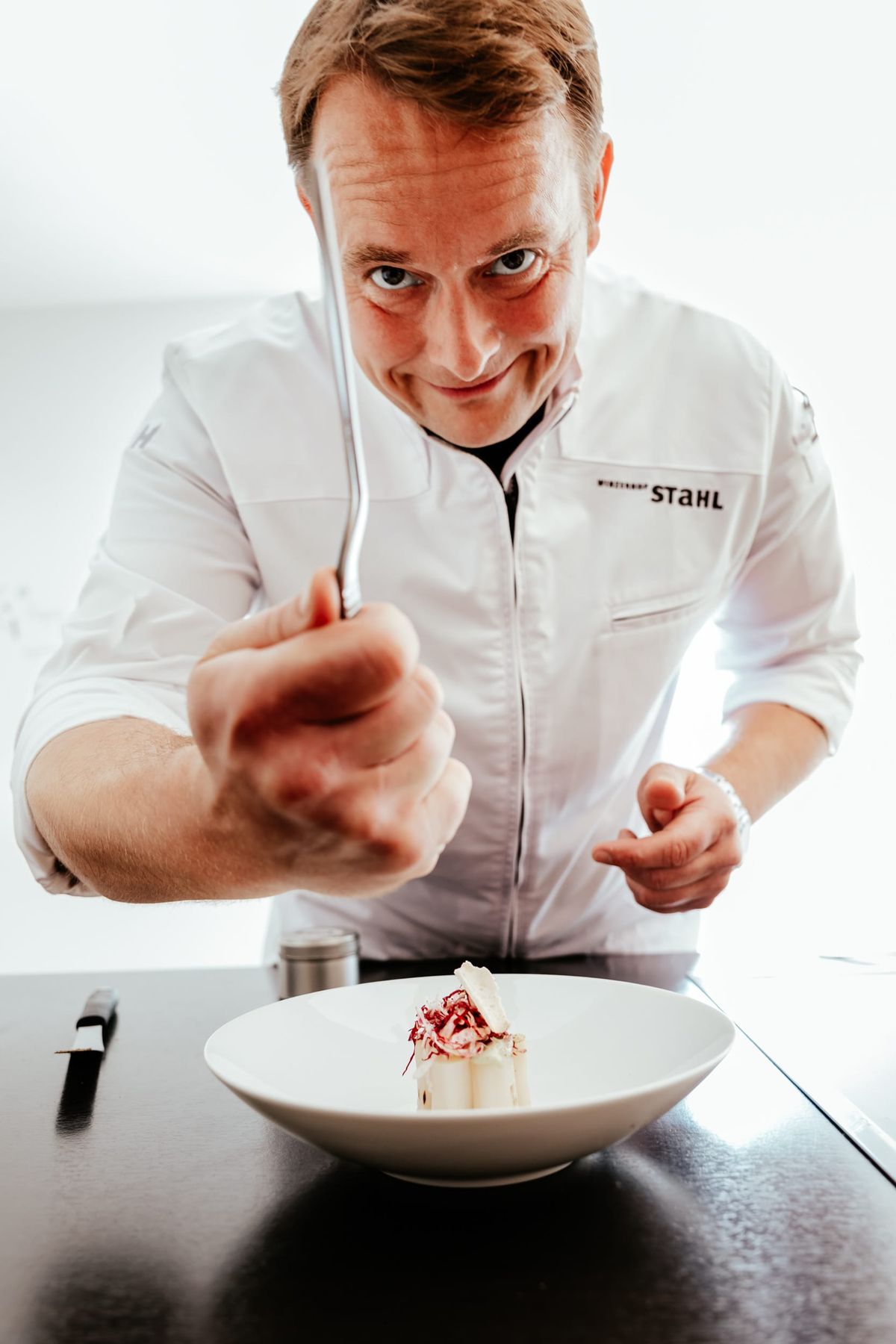
When he first reads the title of this story Christian Stahl (born 1979) will no doubt think, "did Stuart really have to write that?" And yes, I really had to write that because there’s a system behind everything Christian does, and his path as winemaker and chef isn't like how anyone else interprets either of these roles: Stahl-inism.
Although I first met Christian on the 1st June, 2004, it was during 2009 that I really got to know him. That year I borrowed half a dozen rows of Müller-Thurgau vines in the steep Hasennest site from him, cultivated them myself by hand and made an experimental wine in his cellar. One summer day he came by to see how I was doing in the vineyard and started spitting out slogans, of which the most outrageous was, "don’t ask what Stahl can do for you, ask what you can do for Stahl!" OMG. That's a daring extrapolation of something President Kennedy once said about America.
Christian’s cockiness has been getting him into trouble at least since he began studying at the Geisenheim Wine University in 2002. To this day, those who studied with him are either deeply impressed by his achievments or react with anger when his name is mentioned. The wine and gastronomic media in Germany also divide into two clear groups: the fans (the group to which I belong) and those who hate him and his wines. None of this fazes Christian, in fact he relishes being the object of controversly and gets a special twinkle in his eye when this kind of conflict bursts out into the open.
I frequently hear the accusation that his wines are superficial, technical or "made". Christian’s reposnse to this - "all wines are made!" - only infuriates the Anti-Stahl faction even more. Since the natural wine movement became semi-mainstream almost 20 years ago in places like Copenhagen and Paris the myth that natural wines are not made, because they're pre-technological / post-technological, and therefore untainted by human hand has exerted a tight grip on the faithful. For Christian, all of this is nonsense and he never hesitated to say so loudly.
In fact, Christian always says what he thinks and in my presence he never said anything just in order to fit in (psychological term: masking). Some years ago, he wrote something on his website that upset the Weinbauverband Franken, or the winemakers association of his home region. The head of this body and his adjutant travelled to the tiny village of Auernhofen where Christian lives and works. Instead of vineyards, it is surrounded by fields of wheat and soya beans. They told him that what he said was an insult to his fellow members in the association. "That may be, but you’re mistaken about one thing: I’m not a member and I never was!" he replied. Their faces fell and, deeply embarassed by their ignorance, they departed. Of course, he's not a member of Germany's elite VDP wine producers' association, and he never wanted to be. The Quentin Tarrantino of Dry White Wine, as I frequently called him is a Lone Wolf.
These days it’s not so easy to talk to Christian at length, because many evenings he’s cooking at Stahl Restraurant, which began in an experimental form back in 2015. The restaurant occupies what was the apartment Christian and his wife Simone lived in when I did my winemaking experiment there. There’s a fixed 14 (inc. amuse) course menu that’s accompanied by a range of the winery’s current releases. That might sound inflexible, but Christian is a Radical Pragmatist: "We figured out how we could achieve the highest possible standard and decided to only do that." I suggest that the Michelin Star which the restaraunt just recived for the third year running confirms he was right to choose this uncompromising path: Stahl-inism.
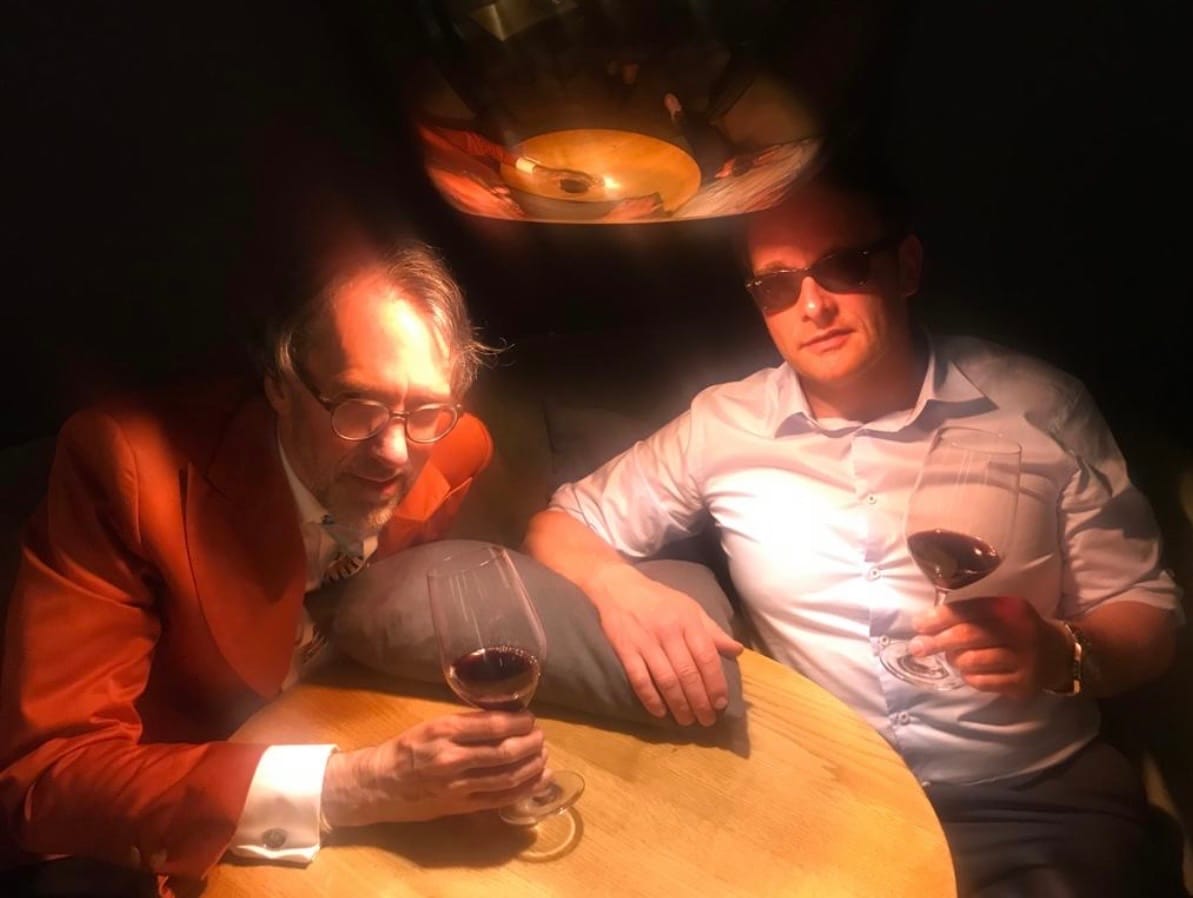
Of couse, this raises the question just how Christian figured out the way to cook a Michelin star, when he has no professional training? From the beginning he worked hard to place his wines on the lists of top restaurants. In the process he befriended a string of top chefs and asked them with genuine curiosity how they do it. Christian took on board everything they said to him, then his relentless determination and perfectionism did the rest. Yes, he has a companion in the restaurant kitchen, and Mirko Schneider had professional training, but for 25 years he worked in a completely different business, before returning to the kitchen with Christian. It’s a pleasure to watch their precise culinary duet, as many people I sent to the restraurant also observed.
The Radical Pragmatist’s approach to winemaking and cooking is based on the conviction that science tells us what is possible and how to achieve various effects. If you combine this knowledge with the best raw materials then you have a "recipe" for excellence. Of course, this is the opposite of the belief that some kind of psuedo-divine inspiration enables those who are "in tune" with nature to achieve results that miraculously defy scientific principals. For Christian, that's bullshit.
Don’t get me wrong, I’m not saying that scientists know everything, but during the last quarter century enormous strides were made in understanding the vine, the grape and what happens in the cellar (also thanks to Geisenheim!) Christian the winemaker never stood still, and when he started making his high-end dry whites in Tonneaux - the German name for double-sized barrique casks or what American winemakers call puncheons - around the same time his experimental restraurant opened he rethought a lot of things. "I had to learn that it was no problem if a few months after the fermentation the wine stank. This reductive aroma passes, but you have to be patient," he told me.
Ever since I first met Christian he’s been adding new wines and entire new wine styles to the winery’s range, and as soon as he’s mastered one, he seeks out a new challenge. First came dry Müller-Thurgau with a depth and complexity far beyond the norm for this "humble" grape. Next up were aromatic dry Scheurebe and Sauvignon Blanc, followed by Champagne-style sparkling wines and now a trio of single-vineyard dry Silvaner from the 2025 vintage. And it's the same with his culinar orientation. This year the regional products and dishes are the focus in the restaurant has shifted to regional products and dishes. Nothing new?
One of Christian’s strengths is the conviction that if you do something extremely well, then the result will be exciting enough to find an audience and be successful. I see a lot of winemakers and chefs - also filmmakers and architects! - with a compulsive need to be ORIGINAL. Of course, those desperate to be oh-so-original often end up with results are not at all original,having wasted a lot of time, energy and money in the process. In spite of this, they often present the results to us as if they'd just reinvented the wheel. This surroagte activity accounts for a signifcant percentage of all social media postings.
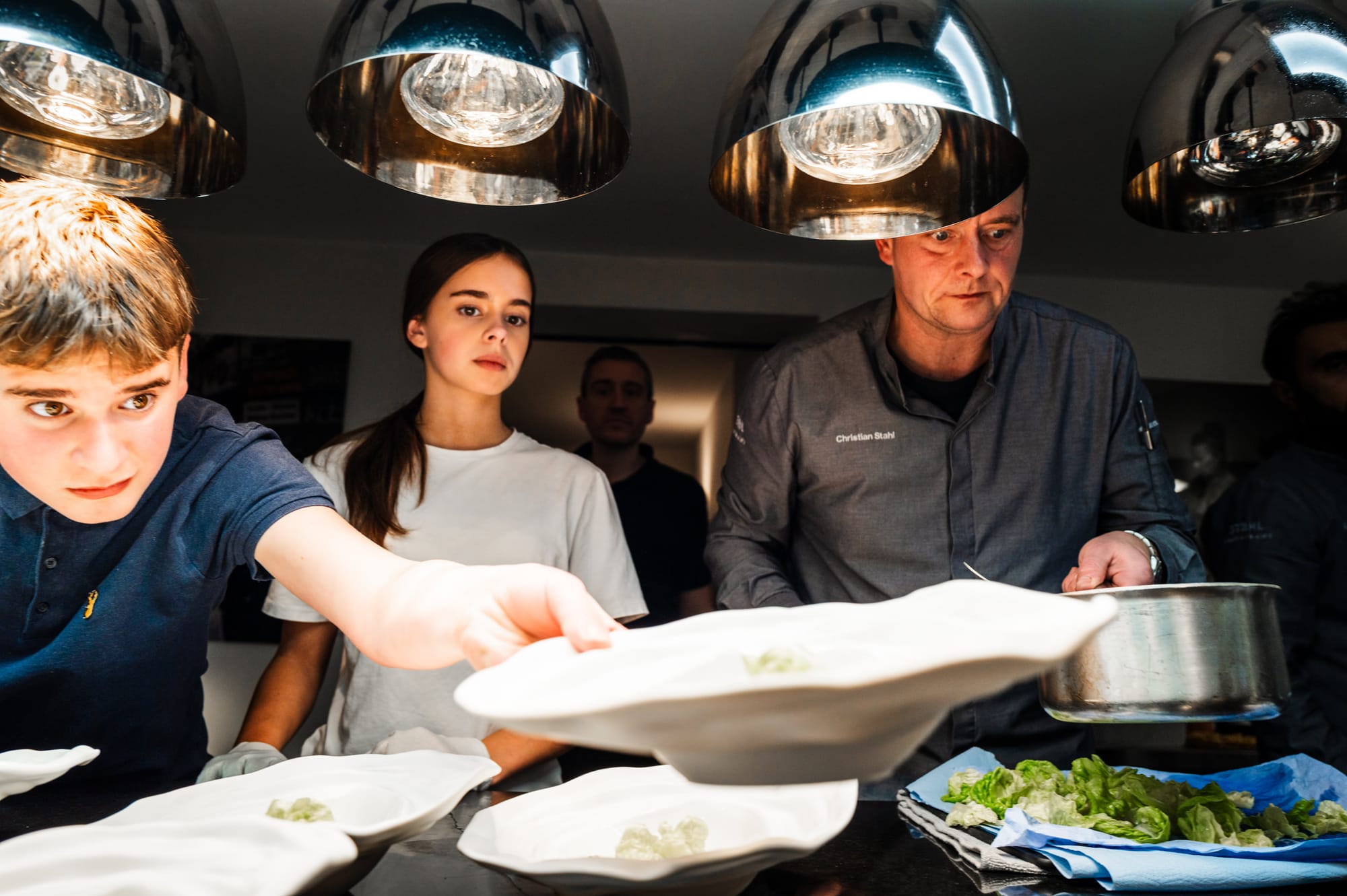
And although Christian has a relentless determination, he finds it rather easy to turn off the perfectionism to just be a husband to Simone, and a father to Mika (born 2023), Mia (born 2017) plus the twins Leon and Lea (born 2010). They both love helping in the restaurant and my sixth sense tells me that they've inherited Christian's Stahl-inism. Let me straight with you: I got infected too!
STANDOUT WINES
Great value for money:
Stahl Franken Müller-Thurgau Hasennest trocken 2025 - 13% / This astonishing Müller-Thurgau starts with an almost surreal explosion of passion fruit, pink grapefruit and spring blossom aromas! So bright and energetic, yet the creamy texture gives it a wonderful mellowness. And then the wave of zesty freshness hits you and all those aromas thatmake the bouquet so exciting rebuond at the long, pristine finish. 93 (SP)
The most exciting of the new releases:
Stahl Franken Blauer Silvaner Sonnenstuhl 2025 - 12.5% / This has to be tasted to be believed! Much closer to a great Chardonnay than the mainstream of high-end Franken Silvaner thanks to its extraordinary textural complexity, and the way serious concentration is made to feel anything but monumental. If only Meursault Premier Cru always tasted this invigorating! Amazing creamy and delicately chalky finish! 96 (SP)
THE COMPLETE TATSING NOTES
24 wines tasted.