WACHAU NOW Part 2: Blue Danube Roller Coaster
Relationship status: it's complicated
By Stuart Pigott - last revision: 04.10.26
This is the second of a series of at least six stories based on my two weeks of research in the Greater Danube Area and Burgenland of Austria in September. WATCH THIS SPACE!
Who can resist the beauty of the Wachau or the aura of Burgundy? One of the things that happens when a wine region gets idealized is that people start to imagine all of the wines from this region must be more or less exciting. The most extreme example of this is Burgundy aka the 21st century's Holy Land of Wine (for the second half of the 20th century Bordeaux held that title). Yes, the reliability of Burgundy wines improved a lot during the last 30 years, but there are still some poor wines and, more importantly, there’s a slew of wines with Premier Cru and Grand Cru names on the label that are absurdly expensive for the quality in the bottle aka reality.
In the Wachau wine prices are not wildly out of control. Yes, there are a bunch of wines that close to or just over 100 Euro per bottle these almost invariably offer great quality. In Burgundy for comparable quality you mostly need to multiply that price by between 3 and 10, and occassionally by 10o+! However, the process of consumer idealization of the Wachau has certainly advanced considerably since the last turn of the century, most extremely in Austria itself, but also perceptibly in the most important metropolises for wine sales around Planet Wine. And that development has lead to the spread of the expectation that any bottle of Wachau wine must at least be good.
At the 2026 Single Vineyard Summit at Schloss Grafenegg in Lower Austria at the beginning of September -organized by the ÖTW producers association of the Greater Danube Area - I spent a whole day tasting through all the Wachau wines shown by members of the Vinea Wachau association. I also visited a number of Wachau wineries to complete the picture, including a prominent non-member of the association: Pichler-Krutzler. What I experienced was a Blue Danube Roller Coaster, but perhaps this shouldn't surprise any of us. You see, there's a fundamental difference between Vinea Wachau and ÖTW: the former is an inklusive association that wants to accomodate as many producers as possible, and the latter is an exclusive club to which new admissions are rare.
Of course, from wine consumers' and critics' points of view there are advantages to exclusivity, most importantly a greater consistency of high quality, though not of style. From the members' point of view there's the combination of a more effective PR than would be possible flying solo, plus the aura of superiority that membership brings with it. And all this fits the ÖTW. An inclusive club like Vinea Wachau gives you a much more realistic picture of the reality on the ground, and in the Wachau this is complex. And the producers may rightly feel that there is more social cohesion within the region asa result.
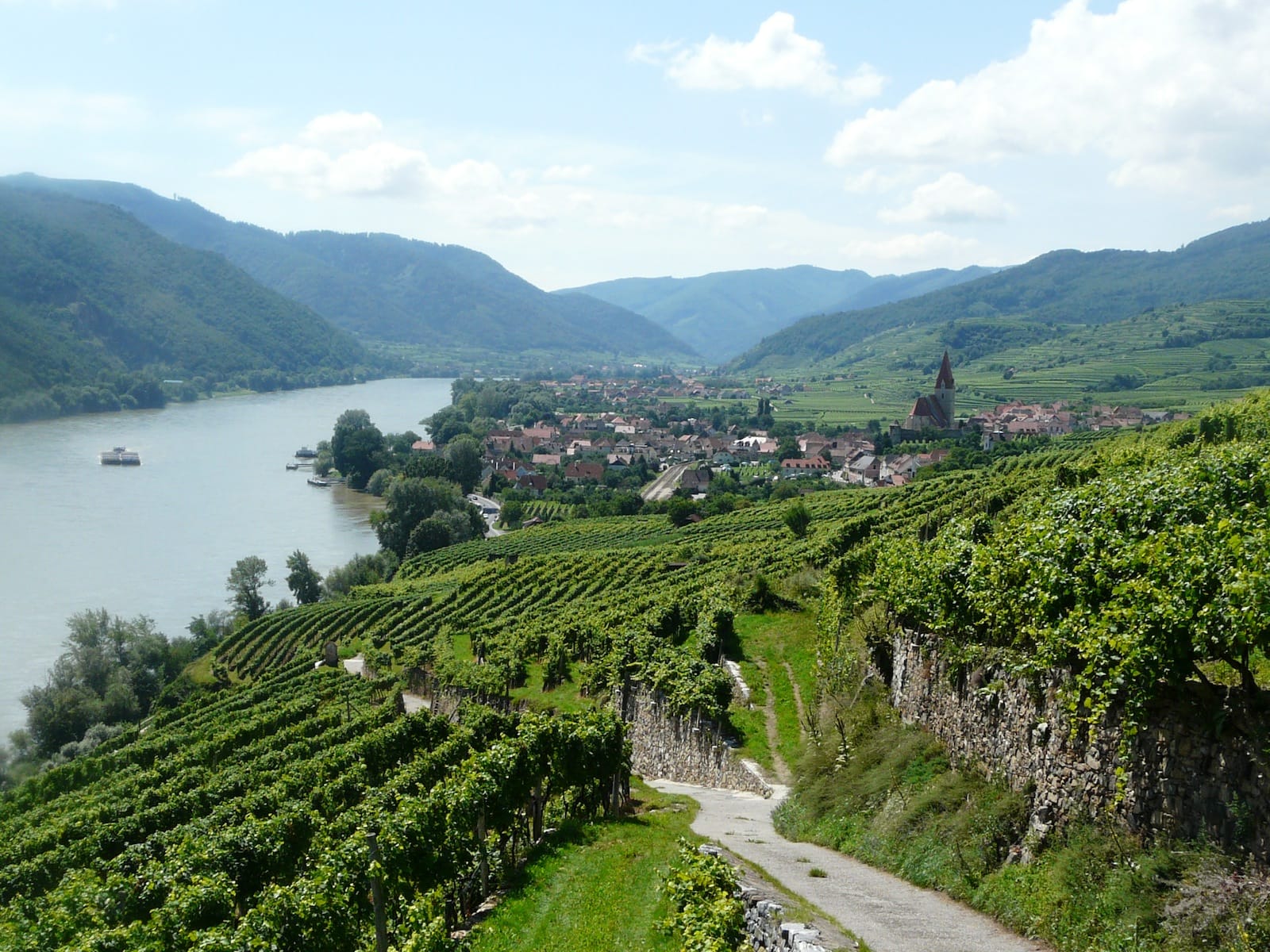
At a superficial glance this statement might look like nonesense, because the first thing you see in the Wachau is the star producers who have been making exciting wines for a long time. In this report Leo Alzinger and Rudi Pichler are the most obvious example of this group. If you're a wine fan, then when you visit the best restaurants and there you will also drink excellent Wachau wines, and both Josef Jamek and Holzapfel, fall into that category. That the region's co-operative winery, Domäne Wachau also makes excellent wines (see Part 1 for their current releases) underlines all this. However, then there are all the Heurigen, or winegrowers wine bars, of the smaller producers, plus other small producers who sell primarily to private customers and may have a couple of importers outside Austria. As this report makes plain, some of these producers make much better wines than others, and there we have the interplay of light and dark you find everywhere on Planet Wine.
Let's finish on a high note, by concentrating on the positives, the light. Of the less famous producers here Johann Donabaum, Georg Frischengruber, Weinhofmeisterei Mathias Hirtzberger, Högl, Holzapfel and Jäger all showed consistently impressive wines in widely divergent styles. Previously Unknown to me Brustbauer also clearly stood out. However, the best wines from Leo Alzinger, Josef Jamek, Rudi Pichler and Pichler-Krutzler were breathtaking and unforgetable. And then, there was the overwhelming beauty of Rudi Pichler's Riesling Ried Achleithen Smaragd 2023, for which you have to scroll all the way to the bottom of the complete tasting notes. Don't worry, because that's anything but Wine Doom Scrolling!
AFFORDABLE INTRODUCTIONS TO WACHAU EXCELLENCE.
Rudi Pichler Wachau Grüner Veltliner Federspiel 2025 - 12.5% / The bright white tree fruits characteris married to a terrific acidity for this grape variety. Excellent depth for this category, but it is the enormous freshness that makes this so exciting. Very long, super-fine finish for this category. A cuvée of wines from 22 parcels that are not terraced. 94 (SP)
Brustbauer Wachau Riesling Ried Hollerin Smaragd 2025 - 13% / Very concentrated and spicy, this remarkable dry Riesling already gives so much, but also has great youthful tension. A deep well of beautiful peachy fruit and stunning mineral energy! 95 (SP)
Georg Frischengruber Wachau Riesling Ried Kreuzberg Smaragd 2025 - 13% / I love the lime zest and lemon blossom aromas of this sleek and unusually racy Wachau dry Riesling. So much spring freshness and Danube energy through the long, pristine finish! Excellent aging potential! 94 (SP)
NOTE: Only for paying subscribers the notes for all 98 wines tasted can be found below. The ratings include one wine with 100, one with 99 and four with 98!